


AI Agent Development Services Powering Intelligent Enterprises
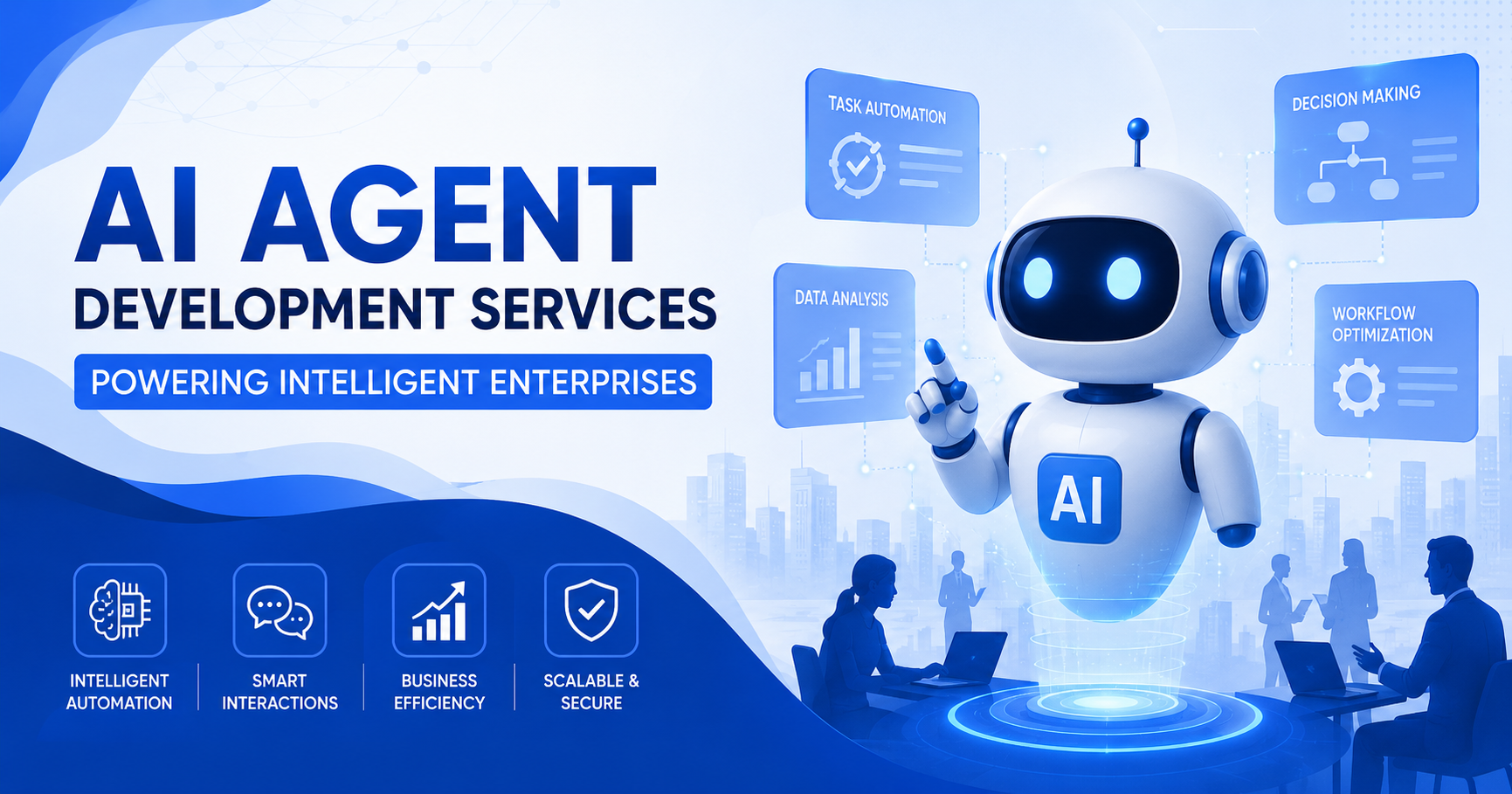
Most enterprises aren't struggling because they lack data. They're drowning in it — spread across CRMs, ERPs, support platforms, spreadsheets, and email threads that nobody has time to synthesize into anything useful before the decision window closes. The real bottleneck isn't information; it's the human bandwidth required to move that information from where it sits to where it actually needs to be, in a form that someone can act on without spending two hours digging through systems first. This is the exact gap AI agents are built to close. Not by replacing the people making decisions, but by handling the connective tissue work — the gathering, the routing, the triggering, the following up — that currently eats through the working hours of some of the most capable people in the organization. When that connective tissue becomes intelligent, the enterprise itself starts to behave differently: faster, more consistent, and finally able to act on the data it's been collecting for years.
The Difference Between an Intelligent Enterprise and a Busy One
Busy enterprises have process. Intelligent enterprises have process that thinks. The distinction sounds abstract until you watch it play out in practice: a busy enterprise has a support team manually triaging tickets by urgency while a backlog grows; an intelligent one has an agent that reads each incoming ticket, cross-references the customer's history, categorizes by priority, and drafts a response — all before a human even opens the queue. The agent doesn't replace the support professional; it means that professional spends their day resolving complex issues rather than sorting simple ones. This is what intelligence at the enterprise level actually looks like: not a flashy AI demo, but a quiet, reliable layer of decision-making that makes every human on the team more effective because the routine work is no longer theirs to carry.
- Agents handle categorization, routing, and first-response drafting automatically
- Human team members shift from execution to oversight and exception handling
- Consistency improves because agents follow the same logic every single time
- Response times compress dramatically when no task waits for a human to notice it
- Enterprise-wide coordination happens in real time rather than through morning email threads
What a Serious AI Agent Development Company Actually Builds
There's a meaningful gap between what gets called an "AI agent" in a product demo and what a serious AI agent development company delivers for an enterprise client. The demo version handles clean, predictable inputs gracefully. The production version handles real data — messy, inconsistent, sometimes contradictory — and still produces reliable outputs without needing a human to catch every edge case before it reaches a customer or triggers a downstream action. Building that reliability requires more than connecting an LLM to a few APIs; it requires careful workflow mapping, thoughtful guardrail design, rigorous testing across failure scenarios, and an architecture that keeps humans informed about what the agent is doing without requiring them to supervise every individual action.
- Workflow mapping that identifies exactly where agent decisions are safe versus where oversight is required
- Guardrail architecture preventing agents from taking unauthorized or high-stakes actions autonomously
- Testing across edge cases and failure modes, not just clean ideal-path scenarios
- Logging and audit trails so every agent action is reviewable after the fact
- Staged rollout process that builds internal confidence before full deployment
Choosing the Right AI Agent Development Services for Your Operations
Evaluating AI agent development services as a business owner without a deep technical background can feel like trying to judge the quality of a foundation before the house is built — everything looks similar on the surface until something fails. The clearest signal tends to come from how a firm approaches the discovery conversation. Teams with genuine depth ask about your existing systems, your data quality, your tolerance for errors in different parts of the workflow, and what "acceptable performance" actually means for your specific use case. Teams without it tend to skip to proposing solutions before they've understood the problem, which almost always means the solution fits their existing templates rather than your actual operations.
- Depth of discovery questioning reveals genuine expertise more reliably than portfolio claims
- Ask how the firm has handled data quality problems in past enterprise deployments
- Clarify what success metrics look like and how they'll be measured post-launch
- Request examples of agents built for your industry rather than general-purpose demos
- Confirm what post-launch monitoring and support looks like before signing anything
Making the Right Match: AI Agent Development Solutions by Business Function
Not every part of an enterprise benefits equally from agent deployment, and trying to automate everything simultaneously tends to produce a project too sprawling to evaluate or improve meaningfully. The right AI agent development solutions start from an honest internal audit of where time is currently being lost to repetitive, rule-following work — and where the volume is high enough that automation creates immediately visible impact. Enterprises that get this right typically start with one or two high-volume, well-understood workflows, build confidence and internal familiarity with the system, then expand systematically from there rather than attempting an organization-wide overhaul from day one.
- Operations: automated data entry, reconciliation, report generation, and anomaly flagging
- Customer experience: ticket triage, first-response drafting, escalation routing
- Finance: invoice processing, expense categorization, compliance documentation
- HR: onboarding coordination, policy question handling, scheduling automation
- Marketing: content brief generation, campaign performance summarization, lead scoring
Why Location Matters: AI Agent Development Services USA
For enterprise deployments specifically, where agents often interact with sensitive customer data, financial records, or internal operational information, the question of where your development partner operates isn't purely logistical. AI agent development services USA partners bring familiarity with the domestic regulatory landscape — HIPAA for healthcare data, SOC 2 for SaaS environments, CCPA for California-based customer interactions — as well as contractual enforceability under U.S. law and time zone alignment for the kind of real-time troubleshooting enterprise deployments occasionally need. These aren't abstract benefits; they become concrete and important exactly when the stakes are highest — during a live incident, a compliance audit, or a critical escalation that can't wait twelve hours for an overseas team's morning to begin.
- U.S. regulatory familiarity across HIPAA, CCPA, SOC 2, and financial compliance frameworks
- Contracts enforceable under domestic law without cross-border legal complexity
- Time zone alignment for real-time support during incidents that can't wait for overseas hours
- Easier coordination on data residency requirements for sensitive enterprise information
- Direct accountability structures that overseas engagements often lack
The Smartest Move: Hire AI Agent Developers Before You Need Them Yesterday
Urgency is the enemy of good technical hiring, and AI agent development is a specialty where the gap between a developer who's shipped real production agents and one who's built demo-level projects is enormous — but not immediately obvious from a resume. Business owners who decide to Hire AI Agent Developers under deadline pressure tend to accept the first apparently qualified candidate rather than evaluating properly, which sets projects up for the kind of mid-development pivots that are expensive and demoralizing. Starting the hiring or vendor selection process during the planning phase, before development pressure has built, creates the space to evaluate candidates or firms properly, run a structured pilot, and build genuine confidence in whoever you're about to trust with a mission-critical system.
- Begin vendor or talent search during strategy phase, not when timelines are already tight
- Use structured pilots or paid test projects to validate real capability before full engagement
- Check specifically for production deployment experience, not just model experimentation
- Involve a technical advisor in evaluation if your own team lacks AI development expertise
- Treat the selection process as a preview of how the working relationship will actually feel
Phone as an Enterprise Interface: AI Voice Agent Development
Enterprise communication still runs heavily through voice — sales calls, support lines, internal helpdesks, partner interactions — and this creates a specific opportunity that text-based agents simply can't address. AI Voice Agent Development for enterprise contexts means building systems that handle inbound and outbound calls with enough natural fluency that callers focus on the content of the conversation rather than the strangeness of talking to software. At enterprise scale, this becomes particularly valuable for after-hours support coverage, high-volume outbound outreach, and internal helpdesk functions where the caller population is predictable enough that the agent can be finely tuned to handle the vast majority of interactions without escalation.
- After-hours inbound coverage without staffing costs or voicemail abandonment
- Outbound call automation for appointment reminders, survey collection, and follow-up sequences
- Internal helpdesk handling for common IT, HR, or facilities requests by voice
- Natural escalation paths that transfer context to human agents seamlessly
- Call summarization and logging that feeds directly into CRM or ticketing systems
Revenue Impact: AI Sales Agent Development at Enterprise Scale
Sales cycles in enterprise environments are long, involve multiple stakeholders, and require consistent follow-through over weeks or months — which is exactly the kind of sustained, structured effort that human sales teams tend to execute inconsistently under real-world workload pressures. AI Sales Agent Development addresses this by ensuring that lead engagement, follow-up sequencing, and qualification steps happen on schedule every time, regardless of how busy the team is or how many deals are competing for attention simultaneously. The result isn't a replacement for experienced sales professionals — it's a system that makes sure qualified opportunities never go cold simply because a rep forgot to send a Tuesday follow-up.
- Immediate lead response the moment inbound interest is registered
- Automated follow-up sequences that maintain consistent cadence across long sales cycles
- Qualification workflows that identify high-intent prospects before routing to human closers
- Meeting scheduling handled end-to-end without manual back-and-forth
- Pipeline data automatically updated as agent interactions produce new qualifying information
Final Thoughts
Intelligent enterprises aren't built by deploying every available technology simultaneously — they're built by identifying where specific capabilities solve specific problems well, and then building those solutions properly rather than quickly. AI agents represent a genuine shift in what's operationally possible for organizations willing to approach the investment thoughtfully, with clear use cases, honest success criteria, and partners who ask better questions than they give answers. The enterprises moving fastest right now aren't the ones who rushed in first; they're the ones who planned carefully and built something that actually works the second time the board asks how it's going.

 Arabic
 French
 Spanish
 Portuguese
 Deutsch
 Turkish
 Dutch
Dutch
 Italiano
 Russian
 Romaian
 Portuguese (Brazil)
 Greek
Greek