


Headless CMS vs Traditional CMS - What's Right for Your New York Business Website in 2026
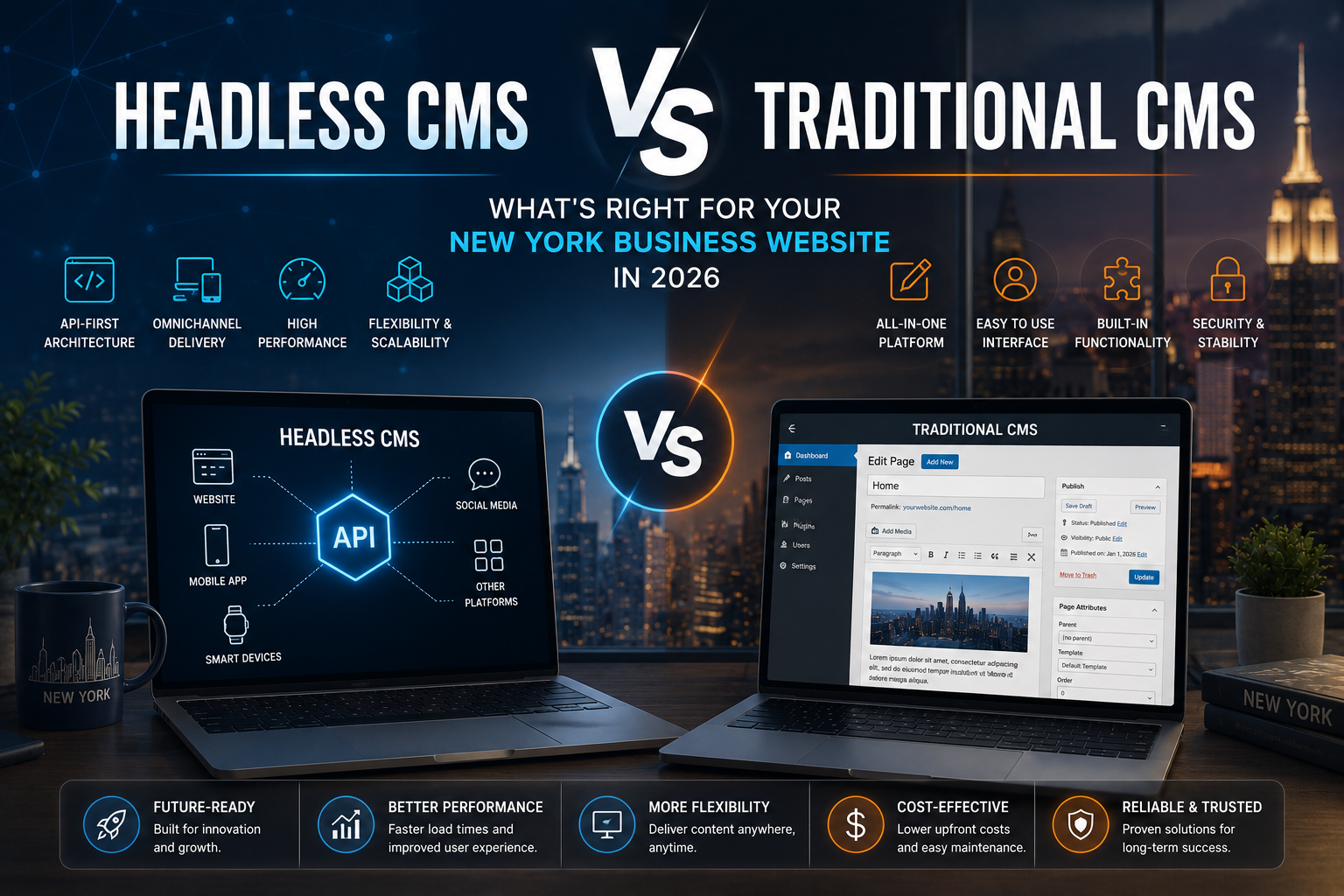
Choosing between a headless CMS and a traditional CMS is one of the most consequential technical decisions a New York business makes when building or rebuilding its website, and most business owners make it based on a developer's preference or a vendor's pitch rather than a genuine understanding of which architecture actually serves their specific business needs, which is exactly why a professional web development company in New York should explain the real tradeoffs honestly before any code gets written.
The CMS choice determines how fast your website loads, how easily your marketing team can update content, how well the site scales as your business grows, how much you'll spend on development and maintenance, and how much flexibility you'll have as your digital needs evolve. Getting it wrong is expensive to fix. Getting it right from the start compounds in your favor for years.
This guide gives New York business owners the honest, practical framework to make this decision confidently, without needing to become a developer to understand the tradeoffs.
What a CMS Actually Does - In Plain Language
A Content Management System is the software that lets your team create, edit, and publish website content without writing code. When a marketing manager updates a product description, a lawyer publishes a new article, or a restaurant owner changes their menu, that happens through the CMS.
Every business website needs some form of CMS. The question is which type best serves your specific combination of content management needs, performance requirements, and technical capabilities.
Traditional CMS: What It Is and How It Works
A traditional (or "coupled") CMS manages both the content and the presentation layers in a single integrated system. WordPress, Drupal, and Squarespace are the most familiar examples.
How it works: Content is stored in the CMS database and rendered as web pages using templates and themes that are part of the same system. Your content editor and your website visitor interact with the same underlying architecture; the CMS "couples" content management and content display together.
What it's good at: Fast time-to-launch, intuitive content editing for non-technical teams, a massive ecosystem of themes and plugins, lower initial development cost, and widespread developer availability for ongoing support.
What it struggles with: Performance at scale (WordPress sites with extensive plugins can be slow and vulnerable), limited flexibility for unconventional designs, difficulty distributing the same content across multiple channels (website + mobile app + digital signage), and technical debt that accumulates as plugin dependencies multiply.
Who it's genuinely right for: New York businesses with content-focused websites (blogs, news sites, professional service firms, restaurants, local businesses) where the primary requirement is a well-designed, regularly updated web presence managed by a non-technical marketing or communications team.
Headless CMS: What It Is and How It Works
A headless CMS separates content management from content presentation. Content is stored and managed in the CMS backend, but instead of generating web pages directly, it delivers content through an API that any frontend, a website, a mobile app, a digital display, or a voice interface can consume and present independently.
How it works: Your content team manages content in the CMS interface (Contentful, Sanity, Prismic, Storyblok are popular examples). Separately, developers build the frontend that displays that content, typically a Next.js or React application, consuming the CMS content via API.
What it's good at: Blazing fast website performance (frontend built with modern frameworks, served via CDN), complete design freedom without template constraints, ability to push the same content to multiple channels simultaneously (website, mobile app, email, digital signage), excellent developer experience, and future-proof architecture as new content channels emerge.
What it struggles with: Higher initial development cost, requires a developer for any significant layout or feature changes, less intuitive content editing experience for non-technical teams (though modern headless CMS platforms have improved substantially), and a smaller pool of NYC developers with headless CMS architecture experience than traditional CMS developers.
Who it's genuinely right for: New York businesses with high performance requirements (e-commerce, high-traffic content sites), multi-channel content needs (simultaneously publishing to website and mobile app), ambitious custom design requirements that templates can't accommodate, or SaaS and technology companies building web platforms rather than traditional marketing websites.
The Real Performance Difference - And Why It Matters in New York
The performance gap between well-built headless sites and traditional CMS sites is substantial and directly measurable.
Google PageSpeed data from 2025 shows that Next. JS-based headless sites regularly achieve scores of 90–98 on mobile, the top tier of performance. Traditional WordPress sites with typical plugin configurations average 45–68 on the same benchmark.
For New York businesses, this performance gap matters in two direct ways:
SEO rankings: Google's Core Web Vitals, which headless sites routinely pass and traditional CMS sites often fail, directly influence search rankings. In New York's competitive local search environment, ranking differences between comparable sites often come down to technical performance rather than content quality.
Conversion rates: Google's research confirms a direct relationship between page speed and conversion rate, a 1-second improvement in load time can increase mobile conversions by 20%. For a New York e-commerce business doing $100,000 per month in online revenue, a 20% conversion rate improvement represents $240,000 in additional annual revenue.
This performance advantage is the primary driver of headless adoption among New York businesses that have run the numbers.
Side-by-Side Comparison for NYC Business Decision-Making
| Factor | Traditional CMS (WordPress) | Headless CMS (Contentful + Next.js) |
|---|---|---|
| Initial Development Cost | $8,000 – $35,000 | $20,000 – $80,000 |
| Time to Launch | 4–8 weeks | 8–18 weeks |
| PageSpeed Score (typical) | 45–70 | 88–98 |
| Content Editor Experience | Excellent (intuitive) | Good (improving rapidly) |
| Design Flexibility | Template-constrained | Unlimited |
| Multi-Channel Publishing | Difficult | Native capability |
| Developer Availability in NYC | Very high | Moderate |
| Ongoing Maintenance Cost | Higher (plugin management) | Lower (cleaner architecture) |
| Scalability | Limited at high traffic | Built for scale |
| Security | Frequent vulnerabilities | More secure by architecture |
The Headless Option NYC Businesses Often Miss: Hybrid/Headless WordPress
There's a third path that many New York businesses are taking in 2026, using WordPress as a headless backend while building a modern Next.js frontend that consumes WordPress content via its REST API.
This approach gives you:
- WordPress's genuinely excellent content editing interface that your marketing team already knows
- Next.js frontend performance that matches purpose-built headless sites
- A much larger pool of NYC WordPress developers than pure headless CMS specialists
- Lower migration cost from an existing WordPress site
The tradeoff is a slightly more complex architecture than either pure WordPress or purpose-built headless, but for many New York businesses with WordPress experience and performance aspirations, it's the most practical path to headless performance without starting from scratch.
How to Decide: A Decision Framework for NYC Business Owners
Choose Traditional CMS (WordPress) if:
- Your primary need is a content-rich website managed by a non-technical team
- Budget is under $20,000 for the build
- Launch timeline is under 8 weeks
- Your content primarily lives on one channel (the website)
- You don't have complex performance requirements or heavy traffic
Choose Headless CMS if:
- You're building an e-commerce site where performance directly affects revenue
- You need to publish content simultaneously to a website and a mobile app
- You have a complex, custom design that templates fundamentally can't accommodate
- You expect significant traffic growth that requires a scalable architecture
- You're building a SaaS platform or web application rather than a marketing website
Consider Headless WordPress if:
- You want headless performance without abandoning WordPress's content editing
- Your team already knows WordPress
- You have an existing WordPress site worth building on rather than replacing
What These Options Cost With a NYC Web Development Company
| CMS Architecture | Development Cost | Ongoing Maintenance |
|---|---|---|
| Traditional WordPress | $8,000 – $35,000 | $200 – $800/month |
| Headless CMS (Contentful/Sanity + Next.js) | $25,000 – $90,000 | $300 – $600/month |
| Headless WordPress | $20,000 – $65,000 | $250 – $700/month |
The higher initial cost of headless is often offset by lower long-term maintenance costs. Headless architectures accumulate less technical debt than WordPress plugin stacks and require less emergency maintenance when plugin conflicts or security vulnerabilities emerge.
FAQ: NYC Business Owners Ask About CMS Choices
Q1. Can my marketing team actually use a headless CMS without developer help?
Modern headless CMS platforms, Contentful, Sanity, and Prismic, have invested heavily in content editor experience and are genuinely usable by non-technical teams for content creation and updating. What marketing teams still need developer help for is layout changes, new page types, and frontend feature additions. This is a real constraint to plan for.
Q2. We're currently on WordPress, and it's slow. Should we migrate to headless?
Evaluate first whether your WordPress performance issues stem from the platform architecture or from optimization problems (excessive plugins, unoptimized images, cheap hosting) that can be addressed without migration. A well-optimized WordPress site on quality hosting with a caching layer can perform significantly better than a slow headless implementation. If you've optimized WordPress and still have performance problems, headless is worth the migration investment.
Q3. How long does a headless CMS migration take for an existing NYC business website?
Migrating an existing website to headless architecture, content migration, frontend rebuild, redirects, and SEO preservation typically takes 10–20 weeks, depending on site size and complexity. Plan for this timeline carefully relative to business priorities and marketing calendar commitments.
Q4. Which headless CMS platform is best for a New York business?
Contentful is the most enterprise-mature with the widest developer availability in NYC. Sanity has excellent developer experience and flexible content modeling. Prismic is more accessible for smaller teams with less technical support. The right choice depends on your content complexity, team technical level, and budget. A web development company in New York familiar with all three can recommend based on your specific situation.
Q5. Will moving to a headless CMS help our Google rankings?
The performance improvements that headless architecture delivers, better Core Web Vitals scores, faster load times, improved mobile experience, directly correlate with better Google rankings for businesses that are currently failing performance benchmarks. If your current site passes Core Web Vitals, the SEO benefit of switching is smaller. If it fails, the performance improvement from headless can be a meaningful ranking factor.
The Bottom Line
The headless vs. traditional CMS decision is genuinely consequential; wrong choices create technical debt, performance problems, and content team frustration that compound over the years. The right choice depends on your specific combination of content management needs, performance requirements, team technical capabilities, and budget. A professional web development company in New York that builds both architectures and can honestly assess which serves your situation better is the right partner for this decision, not one that defaults to the same stack for every client regardless of fit.

 English
 Arabic
 French
 Spanish
 Deutsch
 Turkish
 Dutch
 Italiano
 Russian
 Romaian
 Portuguese (Brazil)
 Greek