


The Real Advantages of Flutter App Development Over Native Builds
Introduction
Choosing between Flutter and native development is one of the first big technical decisions founders face when building a mobile app. Native development has long been considered the gold standard, prized for its deep platform integration and raw performance. But Flutter has closed that gap significantly over the past several years and in many practical business scenarios, it now outperforms native development on the metrics that actually matter most to a growing company: speed, cost, and long-term maintainability. This blog breaks down the real, practical advantages of White Label Flutter App Development over building separate native apps for iOS and Android, and where native development still holds an edge.
Key Takeaways
-
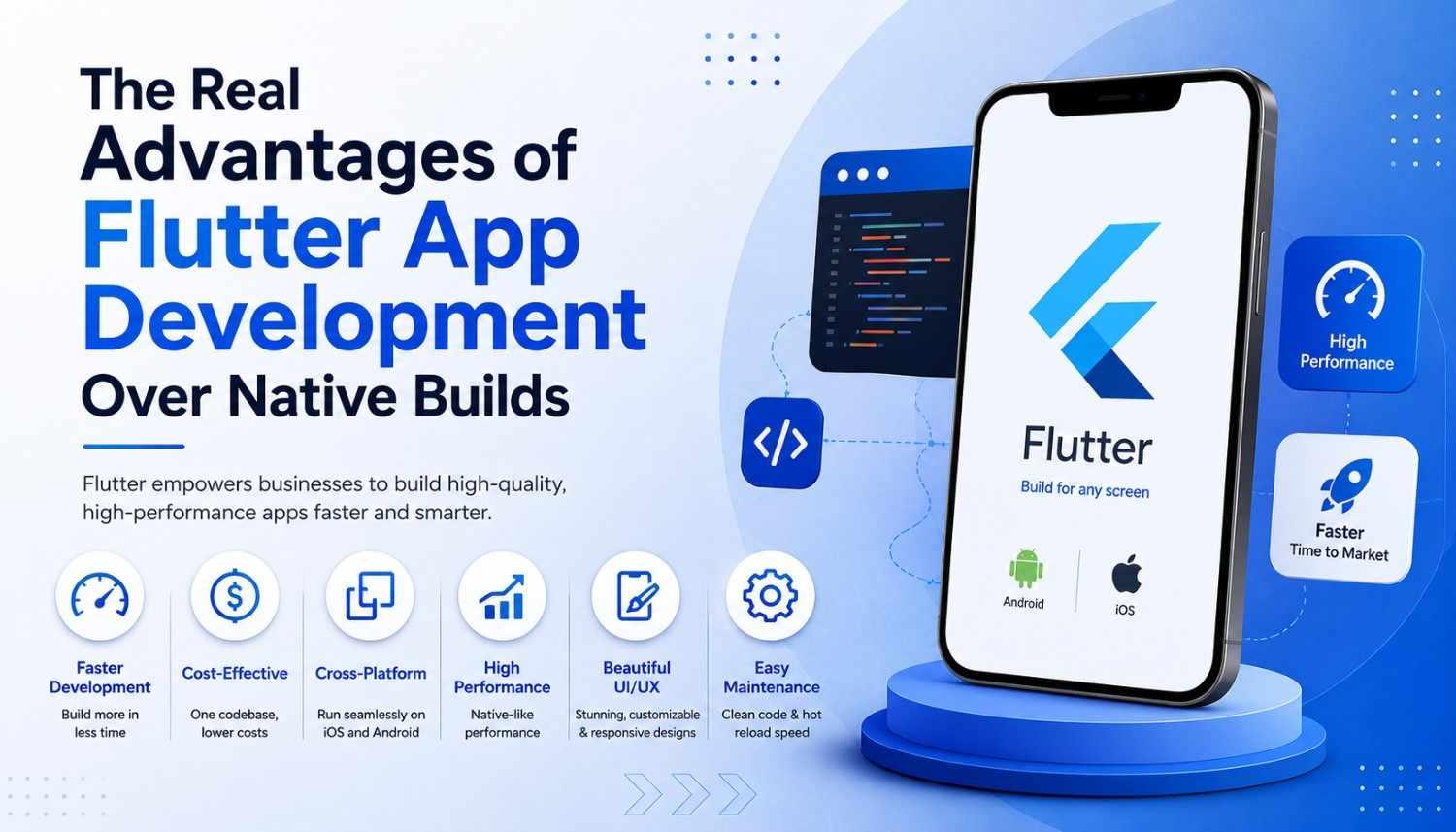
Flutter allows a single codebase to power both iOS and Android apps, cutting development time and cost significantly.
-
Performance differences between Flutter and native apps are minimal for most business use cases.
-
Faster iteration and a large widget library make Flutter especially strong for startups needing to move quickly.
-
Native development still has an edge for highly specialized, hardware-intensive applications.
-
Long-term maintenance costs are often lower with Flutter due to the shared codebase model.
One Codebase, Two Platforms
The most obvious advantage of Flutter app development is that a single codebase builds apps for both iOS and Android simultaneously, instead of maintaining two entirely separate native codebases written in different languages by different specialized teams.
What This Means in Practice
-
One team can build and maintain both platforms instead of needing two separate specialized teams
-
Bug fixes and feature updates only need to be made once, not duplicated across two codebases
-
Faster overall development timeline compared to native builds, often cutting delivery time substantially
-
Lower long-term maintenance costs since there's only one codebase to test, document, and update
-
Simpler onboarding for new developers, since they only need to learn one framework rather than both Swift/Kotlin and their respective platform quirks
This unified approach also reduces the coordination overhead that comes with running two parallel development tracks no more waiting for one platform's team to catch up with a feature the other has already shipped.
Faster Development Without Sacrificing Quality
Flutter's hot reload feature lets developers see changes instantly without restarting the app, which speeds up both development and testing significantly compared to native workflows where recompiling and redeploying can take much longer.
-
Faster UI iteration during the design and testing phase, since visual changes appear almost instantly
-
Quicker bug identification and fixes during development, reducing the feedback loop between writing code and seeing results
-
Reduced overall time from first line of code to app store submission
-
More time available for polishing features and refining UX instead of rebuilding the same logic twice for two platforms
-
Easier collaboration between designers and developers, since design tweaks can be tested live
Performance That Holds Up in Real-World Use
A common misconception is that cross-platform frameworks sacrifice significant performance compared to native apps. In practice, Flutter compiles directly to native ARM code rather than relying on a JavaScript bridge, meaning performance is close to native for the vast majority of business applications e-commerce, booking platforms, social apps, and content-based apps included.
Where Flutter Performs Well
-
Apps with standard UI interactions, animations, and navigation patterns
-
Apps requiring consistent design and behavior across both platforms
-
Apps that don't require deep integration with cutting-edge, platform-specific hardware features
-
Data-driven apps with lists, forms, and dashboards, which make up the bulk of most business applications
Where Native Might Still Be Preferred
-
Apps requiring cutting-edge AR/VR capabilities that rely on the newest platform-specific SDKs
-
Apps needing the absolute latest platform-specific APIs on the very day they're released
-
Highly specialized apps with heavy computational or graphics-intensive workloads, such as advanced gaming engines
-
Apps requiring extremely fine-grained control over battery and memory optimization at the OS level
Consistent Design Across Platforms
Flutter's widget-based architecture makes it easier to maintain a consistent look and feel across both iOS and Android, rather than dealing with two separate design systems that can gradually drift apart as each platform's team makes independent decisions over time.
-
Design consistency reduces user confusion when customers switch between devices
-
Easier to implement brand guidelines uniformly across every screen and interaction
-
Faster design updates since changes apply to both platforms simultaneously, rather than needing to be implemented twice
-
Simplifies QA testing, since testers are validating one consistent design system rather than two divergent ones
Cost Savings That Add Up Over Time
Because Flutter app development requires one team and one codebase, the cost savings compound over the life of the product, not just at the initial launch stage.
-
Lower initial development cost compared to building two separate native apps
-
Reduced long-term maintenance and update costs, since every fix and feature is written once
-
Smaller team required to manage ongoing feature development and support
-
Faster time-to-market means earlier revenue generation and quicker access to real user feedback
-
Lower training and hiring costs, since finding developers skilled in one framework is simpler than finding specialists in two separate native ecosystems
Additional Considerations Before Choosing Flutter
While the advantages are substantial, it's worth going in with realistic expectations about a few nuances.
-
Some highly specialized plugins may still require custom native code for edge cases
-
App size can be slightly larger than an equivalent simple native app, though this gap continues to shrink with each Flutter release
-
Teams entirely unfamiliar with Dart (Flutter's programming language) will need a short ramp-up period, though many developers find it approachable
None of these are significant barriers for the vast majority of business applications, but they're worth factoring into your planning conversations with a development partner.
Conclusion
Flutter app development offers a compelling set of advantages over traditional native builds a single codebase, faster development cycles, strong real-world performance, and significant cost savings that compound over the life of the product. While native development still has a place for highly specialized, hardware-intensive applications like advanced gaming or cutting-edge AR/VR experiences, the vast majority of business apps benefit more from Flutter's speed and efficiency than they would from the marginal gains native development might offer. For startups and businesses that need to move quickly without compromising quality, Flutter remains one of the most practical, well-rounded choices available today.
FAQs
1. Is Flutter app development slower than native in terms of app performance?
No, not meaningfully. Flutter compiles to native code rather than relying on a bridge, and performs comparably to native apps for the vast majority of standard business applications.
2. Can Flutter apps access native device features like camera or GPS?
Yes. Flutter supports plugins and platform channels that give apps full access to native device features and APIs, covering the vast majority of common use cases.
3. Is Flutter app development cheaper than building two native apps?
Generally, yes, since a single codebase covers both platforms, reducing both initial development costs and long-term maintenance costs significantly.
4. Do large companies use Flutter for production apps?
Yes. Several major companies use Flutter for production-grade, high-traffic apps, demonstrating that it scales well beyond small startup projects.
5. When should I choose native development instead of Flutter?
Native development makes more sense for highly specialized apps requiring cutting-edge hardware integration, advanced AR/VR features, or the very latest platform-specific APIs immediately upon release.

 Arabic
 French
 Spanish
 Portuguese
 Deutsch
 Turkish
 Dutch
Dutch
 Italiano
 Russian
 Romaian
 Portuguese (Brazil)
 Greek
Greek