


How Custom Web Applications Drive Digital Transformation
A retail chain in Ohio was running its inventory on spreadsheets three years ago. Store managers emailed stock counts every evening, someone in the head office manually updated a master file, and by the time anyone spotted a shortage, the shelf had already been empty for two days. That's not a hypothetical. It's the kind of daily friction that pushes companies toward web application development in USA markets, because off-the-shelf software rarely fits the exact shape of how a business actually works.
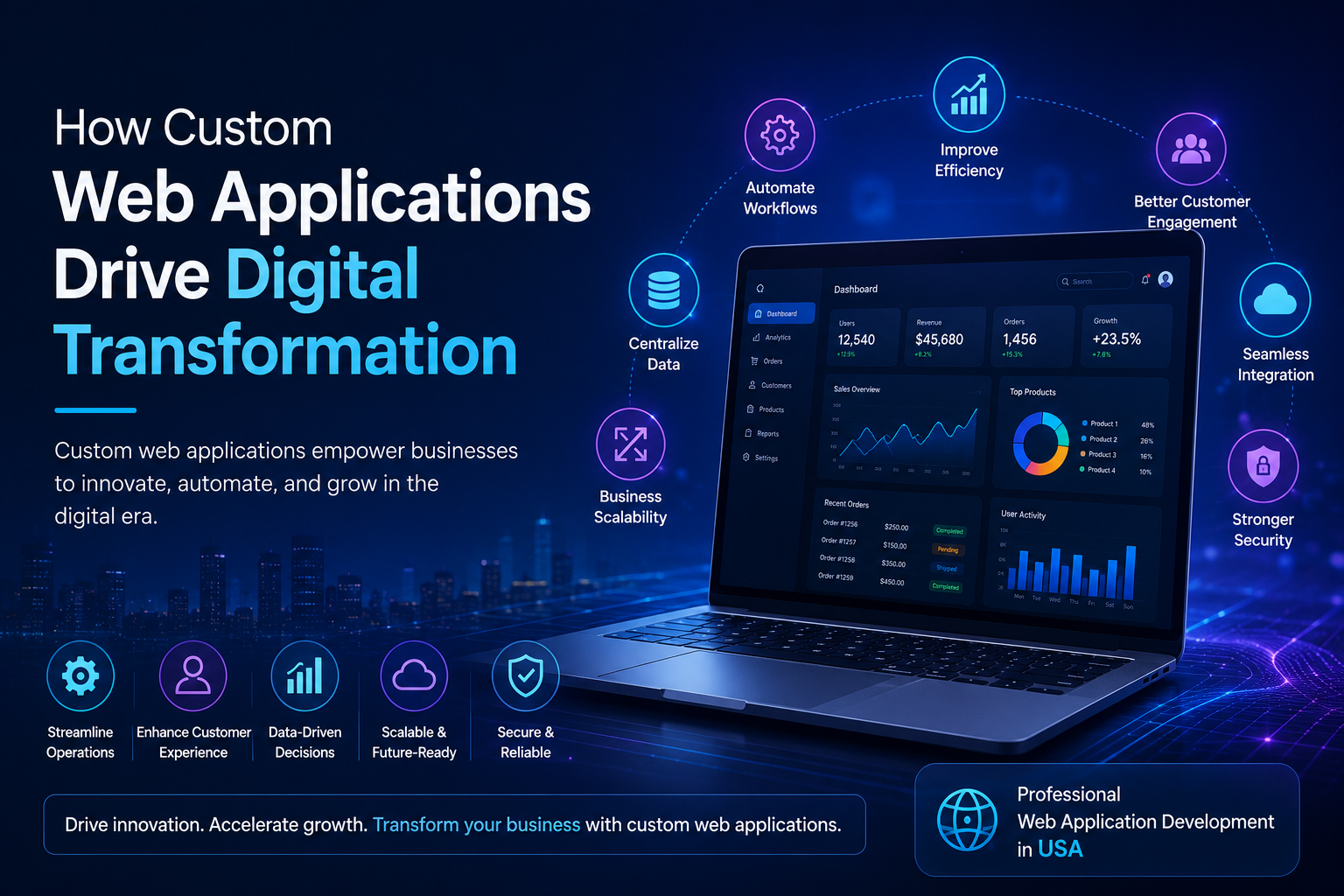
Custom web applications aren't a trend chasing buzzwords. They're the practical backbone of what most people mean when they talk about digital transformation, which is really just a business getting better at using technology to solve its own specific problems instead of bending itself around generic tools.
This piece looks at how that actually plays out, not in theory, but in the day-to-day mechanics of running a company.
Why Businesses Are Turning to Custom Web Applications
Generic software solves generic problems. A retail business, a logistics company, and a healthcare provider all have wildly different workflows, yet most out-of-the-box platforms force them into the same rigid structure.
Web application development in USA companies has grown steadily because businesses are tired of paying for features they don't need while missing the ones they actually do. A custom-built application is designed around how a specific team already works, not the other way around.
The Shift From Off-the-Shelf to Purpose-Built
Ten years ago, buying a licensed software package was the default move. Today, more companies are commissioning applications tailored to their exact processes, because the cost of forcing a team to adapt to rigid software often outweighs the cost of building something that fits.
This shift shows up clearly in mid-sized businesses. A company with 50 to 200 employees usually has just enough complexity in its operations that generic tools start creating more friction than they solve.
Improving Business Efficiency Through Custom Applications
Efficiency gains from custom software rarely come from one big feature. They come from removing dozens of small annoyances that add up across a workday.
Take a mid-sized logistics company that used to track shipments across three disconnected systems: a spreadsheet for scheduling, an email chain for driver updates, and a separate app for customer notifications. A custom dashboard that pulled all three into one screen cut their daily coordination time by roughly a third, simply because staff stopped switching between tools.
That's the pattern with most efficiency wins. It's not about adding new capability, it's about removing the gaps between existing ones.
Where Efficiency Gains Usually Show Up
- Fewer manual handoffs between departments
- Less time spent reconciling data across separate tools
- Faster access to information staff need multiple times a day
- Reduced errors from duplicate data entry
Automating Workflows That Used to Eat Up Staff Time
Workflow automation is where a lot of businesses see the fastest return on a custom build. Repetitive tasks that used to take a person twenty minutes a day, done manually, add up to real payroll cost over a year.
A regional accounting firm we've seen referenced in industry case studies automated its client onboarding process, cutting a task that used to take two days of back-and-forth emails down to a same-day turnaround. The application handled document collection, basic validation, and routing to the right team member without anyone needing to chase it manually.
Common Processes Businesses Automate First
- Approval chains that used to run through email threads
- Data entry between disconnected systems
- Client or customer onboarding steps
- Routine reporting that used to be pulled together by hand
None of this requires exotic technology. It requires software built specifically around how a company's existing process actually runs, which is exactly what custom development is meant to do.
Enhancing Customer Experience With Tailored Digital Tools
Customers notice friction even when they can't name it. A checkout flow with too many steps, a support portal that doesn't remember previous conversations, a booking system that doesn't sync with actual availability, these things quietly push people toward competitors.
A custom-built customer portal lets a business shape the experience around what its specific customers actually need, rather than whatever a generic template happened to include. A B2B distributor, for example, might need bulk ordering and account-specific pricing baked directly into the interface, something a standard e-commerce platform usually can't handle without heavy workarounds.
Small Details That Make a Real Difference
- Personalized dashboards based on account history or preferences
- Faster load times because the application only carries features that matter to that specific business
- Support flows that pull in past interactions automatically
- Mobile-friendly interfaces built for how customers actually browse today
Good customer experience isn't usually one dramatic feature. It's the accumulation of small frictions that a generic platform never bothered removing.
Enabling Data-Driven Decision-Making
Most businesses collect more data than they actually use. The gap isn't a lack of information, it's a lack of a system that turns that information into something a manager can act on without spending hours pulling reports together.
Custom applications solve this by building reporting and analytics directly into daily workflows rather than treating them as a separate task someone has to remember to do. A manufacturing company tracking production line performance in real time can catch a slowdown the same day it happens, instead of finding out three weeks later during a monthly review.
What Real-Time Data Actually Changes
Decisions that used to wait for a weekly or monthly meeting can now happen the moment a pattern shows up. That's a meaningful shift for businesses where a delayed decision has a real cost attached to it, whether that's a supply chain gap or a customer complaint that could have been caught earlier.
Integrating With Existing Systems Instead of Replacing Them
One of the biggest misconceptions about digital transformation is that it means ripping out everything a business already uses. In practice, most successful projects work the opposite way. They build custom applications that connect existing systems together rather than replacing them wholesale.
A healthcare clinic, for instance, might keep its existing patient records system but add a custom scheduling application that talks to it directly, removing the need for staff to manually update two separate places every time an appointment changes.
Why Integration Matters More Than Replacement
Ripping out established systems is expensive, disruptive, and risky, especially for businesses with regulatory requirements around data handling. Custom applications built with proper API integration let a business modernize gradually, keeping what already works while fixing what doesn't.
This approach also tends to get less internal resistance. Staff aren't being asked to abandon a system they know, they're being given a tool that removes the manual work sitting between systems they already use.
Improving Scalability as the Business Grows
A tool that works fine for a ten-person team can fall apart the moment that same company scales to fifty. Off-the-shelf software often has hard limits on user counts, data volume, or customization that only become obvious once a business hits them.
Custom applications are built with growth in mind from the start, meaning the architecture can handle increased load, additional users, or new features without needing a complete rebuild every eighteen months.
Signs a Business Has Outgrown Its Current Tools
- Reports take noticeably longer to generate than they used to
- Adding a new team member requires workarounds the software wasn't designed for
- Features that used to be "nice to have" have become daily bottlenecks
- Support tickets with a vendor take longer to resolve as the account grows more complex
Scalability isn't just a technical concern. It directly affects how much a business can grow before its own tools start holding it back.
Supporting Long-Term Digital Transformation
Digital transformation isn't a single project with a finish line. It's an ongoing process of a business getting better at using technology to support how it actually operates, and that process rarely stops once the first custom application goes live.
Companies that invest in web application development in USA markets tend to treat that first build as a foundation rather than a one-time fix. The applications get expanded, refined, and connected to new systems as the business itself changes.
What Sustained Transformation Looks Like in Practice
A company might start with one custom application solving a single bottleneck, like automating invoicing. Over the following two years, that same foundation often expands to cover inventory management, customer support workflows, and internal reporting, because the initial build was designed to grow rather than stay static.
This is where working with an experienced development partner matters. A team that understands a business's long-term direction can build applications that don't need to be scrapped every time a new requirement shows up.
Real-World Impact Across Different Industries
The pattern of custom applications solving specific bottlenecks repeats across nearly every industry, even though the details look different each time.
A construction firm managing multiple job sites replaced a patchwork of paper timesheets and phone calls with a custom application that let site supervisors log labor hours, material usage, and equipment status directly from a tablet. Payroll processing that used to take three days shrank to a same-afternoon task, and disputes over logged hours dropped sharply because everything was timestamped and visible to both sides.
A regional insurance broker built a custom client portal that let policyholders file claims, upload documents, and check status without calling the office. Call volume on routine status checks dropped by more than half within the first two quarters, freeing staff to spend that time on actual claims work instead of answering the same "where's my claim" question repeatedly.
A specialty food distributor working with dozens of retail accounts needed pricing and ordering rules that varied by customer, something a standard e-commerce platform simply couldn't accommodate. A custom ordering system built those rules directly into the checkout flow, cutting order errors that used to require manual correction almost to zero.
None of these examples involve unusual technology. What they share is a development approach that started with the actual bottleneck a business was facing, rather than starting with a feature list and hoping it would fit.
The Common Thread
In each case, the business didn't set out to "digitally transform" as an abstract goal. They had a specific, painful problem, and the custom application was the tool that solved it. The transformation happened as a byproduct of solving real operational pain, not the other way around.
Weighing the Cost Against the Long-Term Return
Cost is usually the first question a business asks, and it's a fair one. Custom development costs more upfront than buying a licensed off-the-shelf tool, and any honest development partner should say so directly rather than glossing over it.
The comparison that actually matters isn't the sticker price of software versus a custom build. It's the ongoing cost of the workarounds, manual labor, and lost time that generic software quietly creates month after month. A subscription tool that costs less upfront but requires two staff hours a day of manual reconciliation adds up to a real number over a year, one that often outpaces what a custom solution would have cost to build and maintain.
Questions Worth Asking Before Committing to a Build
- How much staff time is currently spent working around limitations in existing tools
- Whether the business is paying for software features that go largely unused
- How much a data error or delayed decision typically costs when it happens
- Whether current tools can realistically support the business at twice its current size
These aren't questions with universal answers. They depend entirely on the specific business, which is exactly the point. A generic tool was never going to answer them properly in the first place.
Choosing the Right Web Application Development Partner
Not every development team approaches custom software the same way. Some focus purely on writing code to a fixed spec, while others take the time to understand how a business actually operates before recommending a build.
The difference shows up months after launch, not on day one. A well-built application should still make sense a year later, adapting as the business changes rather than becoming outdated the moment new requirements appear.
What to Look for in a Development Team
- A track record of building for the specific industry, not just general software experience
- Willingness to explain technical decisions in plain language, not just deliver a finished product
- A clear process for maintenance and updates after the initial launch
- Experience integrating with systems a business already relies on
Final Thoughts
Custom web applications aren't about chasing the latest technology for its own sake. They're about giving a business tools that actually match how it operates, which is exactly why so many companies pursuing digital transformation end up here eventually, whether they started with efficiency problems, customer experience gaps, or simply outgrowing what generic software could offer.
If your business is dealing with disconnected systems, manual workarounds, or software that no longer fits how your team actually works, it might be time to look into web application development in USA companies that build around your specific operations rather than asking you to adapt to theirs. A conversation with an experienced development team costs nothing, and it usually clarifies a lot more than another round of workarounds ever will.
Frequently Asked Questions
1. How long does custom web application development usually take?
Timelines vary based on complexity, but a mid-sized business application typically takes three to six months from planning through launch, with simpler tools completed faster.
2. Is custom web application development worth it for a smaller business?
Yes, if off-the-shelf tools are creating regular workarounds or manual data entry. Smaller businesses often see the fastest return since even modest automation removes a meaningful chunk of daily admin work.
3. Can a custom application integrate with software we're already using?
In most cases, yes. Proper API integration is a standard part of modern web application development in USA projects, letting new tools connect with existing systems instead of replacing them.
4. What's the difference between a custom web application and a mobile app?
A web application runs through a browser and works across devices without needing a download, while a mobile app is installed directly on a phone or tablet. Many businesses use both, depending on how their customers or staff actually access the tool.
5. How do we know if our business needs a custom application instead of an off-the-shelf tool?
If your team regularly works around software limitations, exports data to manually combine it elsewhere, or pays for features you never use, that's usually a sign a custom build would pay for itself over time.

 English
 Arabic
 French
 Spanish
 Portuguese
 Deutsch
 Turkish
 Dutch
Dutch
 Italiano
 Russian
 Romaian
 Portuguese (Brazil)