


10 Powerful Benefits of Color Flashcards for Smarter Learning
Introduction
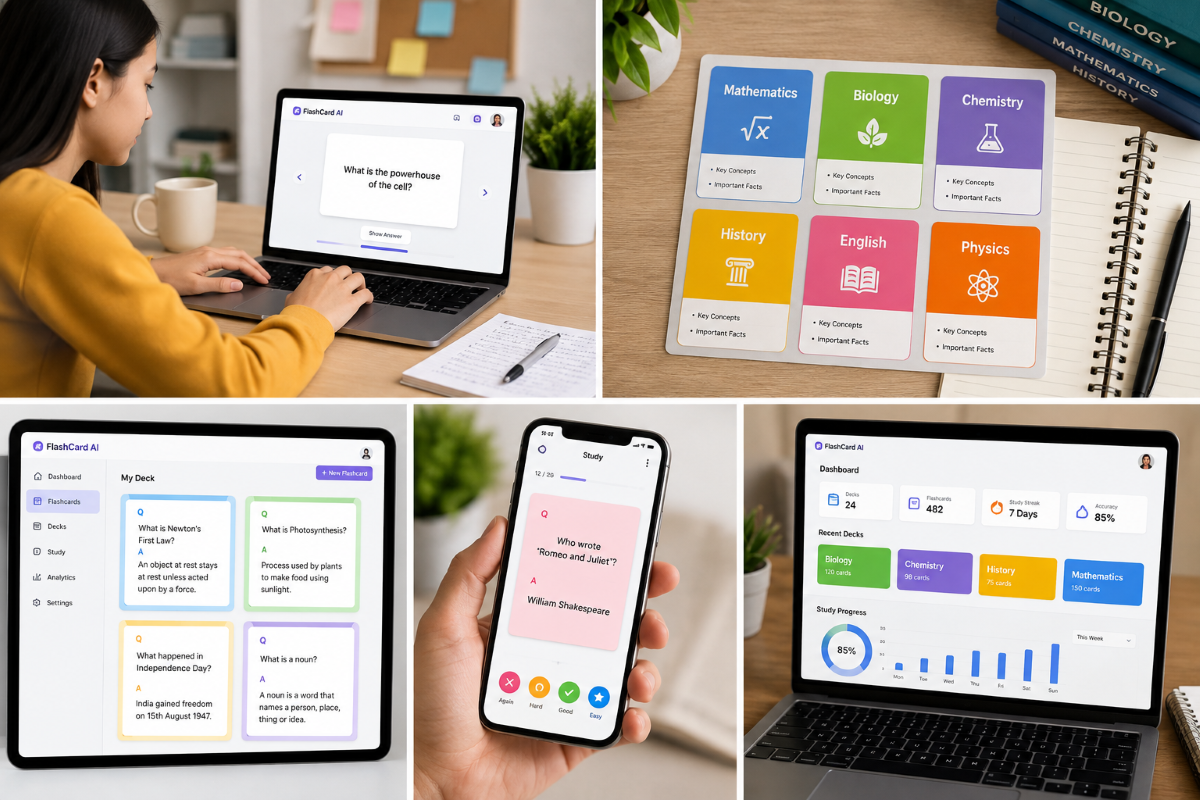
Learning can become easier when study materials are clear, simple, and visually organized. Color flashcards add a visual element to traditional flashcards, helping learners group information, highlight important concepts, and make revision more engaging. Different colors can be used to separate subjects, identify difficult topics, or make key information easier to recognize.
Digital flashcards make this process even more convenient. With tools such as FlashCard AI, learners can create, organize, and review digital study materials while using color and structure to make their learning experience more effective.
Quick answer: Color flashcards are study cards that use different colors to organize or highlight information, making revision more visual, structured, and engaging.
What Are Color Flashcards?
Color flashcards are flashcards that use colors as part of their design or organization.
A basic flashcard usually contains a question on one side and an answer on the other. Color can be added to make specific information easier to identify.
For example:
- Blue: Definitions
- Green: Important facts
- Yellow: Vocabulary
- Red: Difficult topics
- Purple: Key formulas
This system allows learners to create visual categories that make study materials easier to navigate.
Color flashcards can be physical cards or digital cards created through an online flashcard maker.
10 Benefits of Using Color Flashcards
1. Makes Study Material More Visual
One of the main benefits of color is that it makes information more visually organized.
A page containing only black text can look repetitive. Adding appropriate colors can create visual differences between topics.
For example:
Blue cards → Biology
Green cards → Chemistry
Yellow cards → Physics
This simple system can help learners recognize categories quickly.
2. Helps Organize Different Subjects
Students often study several subjects at the same time.
Color coding can provide an easy way to separate study materials.
For example:
Mathematics
Use blue cards for formulas.
Biology
Use green cards for definitions.
History
Use orange cards for important dates.
English
Use purple cards for vocabulary.
This organization can make it easier to choose the right study set without searching through every card.
3. Makes Flashcards More Engaging
Studying the same type of material for a long time can feel repetitive.
Color can add variety to flashcards and make study sessions more visually interesting.
Instead of seeing identical cards, learners can use different colors to represent different categories.
This does not automatically improve memory, but it can make study materials more appealing and easier to organize.
4. Highlights Important Information
Color can be used to draw attention to information that deserves extra review.
For example:
- Green: Already understood
- Yellow: Needs more review
- Red: Difficult
- Blue: Important concept
This creates a simple visual system for identifying learning priorities.
A student can then focus more attention on red or yellow cards during revision.
5. Supports Vocabulary Learning
Color flashcards can be especially useful for language learning.
For example, learners can use:
- Blue for nouns
- Green for verbs
- Yellow for adjectives
- Purple for phrases
A vocabulary flashcard might look like this:
Front: Beautiful
Back: Attractive or pleasing to look at.
The color category can help the learner immediately recognize the type of vocabulary being studied.
6. Can Help Organize Difficult Topics
Not every topic is equally easy.
Learners can use a color system to identify areas that need additional practice.
For example:
Green: Easy
Yellow: Moderate
Red: Difficult
During revision, students can focus on the red cards first and gradually move cards into easier categories as their understanding improves.
This creates a simple way to organize study priorities.
7. Works Well With Digital Flashcards
Digital flashcards provide additional flexibility because colors can be changed or updated without creating a new physical card.
A digital flashcard platform can allow users to organize cards by topic, category, or learning level.
With FlashCard AI, learners can combine digital flashcard creation with organized study sets and visual learning techniques.
Digital cards can also be easier to update when study material changes.
8. Makes Revision Easier to Navigate
A large collection of flashcards can become difficult to manage.
Color categories provide visual signals that can help users find the right cards.
For example:
Red cards → Exam topics
Blue cards → Definitions
Green cards → Examples
Instead of reviewing every card, learners can select a specific color category based on what they want to practice.
9. Useful for Different Learning Goals
Color flashcards are not limited to school subjects.
They can be used for:
- Language learning
- Exam preparation
- Professional training
- General knowledge
- Vocabulary
- Definitions
- Formulas
- Historical dates
- Computer science
- Business concepts
The color system can be customized according to the learner's needs.
10. Can Make Study Sessions More Structured
A good color system can give learners a clear study structure.
For example:
Step 1
Review green cards that you already understand.
Step 2
Practice yellow cards that need more attention.
Step 3
Focus on red cards that are difficult.
Step 4
Review all categories before the exam.
This simple process can make study sessions feel more organized.
How to Create Effective Color Flashcards
Creating useful color flashcards does not require a complicated design.
Follow these steps:
1. Choose a Color System
Decide what each color means before creating your cards.
2. Keep the System Consistent
Use the same colors throughout the study set.
3. Add One Main Idea Per Card
Avoid putting too much information on one card.
4. Write Clear Questions
Questions should be short and easy to understand.
5. Keep Answers Concise
Use simple explanations rather than long paragraphs.
6. Review the Cards
Check every card for spelling, accuracy, and clarity.
7. Update Difficult Cards
Rewrite cards that are confusing or contain too much information.
Using a Flashcard Maker Online
A flashcard maker online can make the process easier by allowing learners to create digital cards without designing them manually.
A typical workflow is:
Choose a topic → Create cards → Add colors → Organize categories → Review → Edit → Study
Online flashcard tools can be useful because users can update their cards quickly and keep study materials organized digitally.
When using AI-assisted tools, always check generated information for accuracy before relying on it for important academic or professional learning.
Frequently Asked Questions
What are color flashcards?
Color flashcards are study cards that use different colors to organize, categorize, or highlight information.
Are color flashcards useful for studying?
Yes. They can make study materials more visual and provide a simple system for organizing subjects, topics, or difficulty levels.
Can color flashcards help with vocabulary?
Yes. Learners can assign different colors to nouns, verbs, adjectives, phrases, or other vocabulary categories.
Can I create color flashcards online?
Yes. An online flashcard maker can allow users to create and organize digital flashcards with different designs and categories.
How many colors should I use?
There is no fixed number, but keeping the system simple is usually better. Using a few consistent colors can be easier to remember than using many different colors.
Can color flashcards improve memory?
Color can help organize and distinguish information, but it does not guarantee better memory. Effective learning also depends on active recall, regular review, and understanding the material.
Can FlashCard AI be used for digital flashcards?
FlashCard AI can be used as a brand focused on digital flashcard learning and organized study materials.
Conclusion
Color flashcards provide a simple way to make study materials more visual, organized, and engaging. By assigning specific colors to subjects, categories, difficulty levels, or important concepts, learners can create a clear system for reviewing information.
Using a flashcard maker online can make digital flashcard creation even more convenient. With FlashCard AI, learners can explore a modern approach to creating and organizing digital study materials.
The most important factor is not the number of colors used but how consistently they are applied. A simple color system combined with active recall, regular revision, and accurate study material can make flashcards a valuable part of a learner's study routine.
For more detail visit:https://calisthenics.mn.co/posts/powerful-benefits-of-ai-flashcard-generator-for-smarter-learning

 English
 Arabic
 French
 Spanish
 Portuguese
 Deutsch
 Turkish
 Dutch
 Russian
 Romaian
 Portuguese (Brazil)
 Greek