


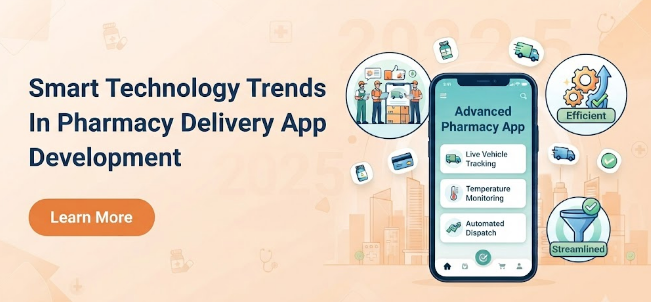
Smart Technology Trends in Pharmacy Delivery App Development
Introduction
Technology is continuously changing the way healthcare businesses interact with customers and manage essential services. Mobile applications, cloud infrastructure, artificial intelligence, automation, and connected digital systems are helping businesses create faster and more convenient service experiences. For companies operating in the medicine delivery sector, adopting the right technology can improve operational efficiency while creating opportunities for future growth.
Modern pharmacy delivery app development is no longer limited to creating a simple application for browsing products and placing orders. Businesses are increasingly exploring intelligent systems for automation, delivery optimization, data analysis, customer support, and personalized digital experiences. At the same time, privacy, security, interoperability, and responsible technology adoption are becoming increasingly important across digital healthcare.
Smart technology trends are helping businesses transform traditional workflows into connected digital ecosystems. From AI-powered assistance to IoT-enabled monitoring and secure data infrastructure, the future of pharmacy delivery platforms is becoming more intelligent and adaptable.
What Is Pharmacy Delivery App Development?
Pharmacy delivery app development refers to the process of creating digital platforms that help customers search for eligible products, place orders, submit prescriptions when required, make payments, and receive delivery updates.
A complete platform can connect multiple users, including:
-
Customers
-
Pharmacy businesses
-
Delivery partners
-
Administrators
-
Healthcare service providers
The system can include mobile applications and web-based dashboards designed for different roles.
How Does a Smart Pharmacy Delivery Platform Work?
A customer begins by searching for available products through the application. After selecting suitable items, the customer can place an order and complete the required verification process.
The business receives the order and prepares it for fulfillment. Once ready, the platform can coordinate delivery operations and provide relevant updates to the customer.
Smart technology improves this workflow by introducing automation, intelligent recommendations, analytics, and better coordination between different participants.
Why Technology Is Important for Modern Pharmacy Businesses
Customer expectations are changing rapidly. People increasingly prefer services that provide convenience, speed, transparency, and easy access.
Businesses therefore need technology that can support:
-
Faster order processing
-
Better customer communication
-
Improved inventory visibility
-
Efficient delivery management
-
Secure transactions
-
Personalized experiences
-
Scalable operations
The objective is not simply to add advanced technology. Businesses should select tools that solve genuine operational and customer challenges.
1. Artificial Intelligence for Smarter Operations
Artificial intelligence is becoming one of the most important technologies influencing digital healthcare platforms.
AI can support businesses by analyzing data, automating routine tasks, and improving decision-making processes. In healthcare, AI-driven tools are increasingly being explored for administrative workflows, virtual assistance, and intelligent service delivery, although responsible governance and human oversight remain essential.
AI-Powered Customer Assistance
AI chat assistants can help users navigate an application and find general platform information.
For example, an assistant may help customers understand:
-
Order status
-
Platform navigation
-
Available service areas
-
General product categories
-
Delivery-related information
Sensitive medical questions should be appropriately directed to qualified professionals rather than relying solely on automated responses.
AI-Based Demand Analysis
Businesses can analyze historical order patterns to identify changes in customer demand.
These insights may help operational teams improve inventory planning and resource allocation.
2. Smart Automation for Faster Workflows
Automation is helping businesses reduce repetitive manual activities.
Instead of requiring employees to manually manage every notification and status update, digital platforms can automate routine workflows.
Automated Order Notifications
The application can automatically notify customers when their order reaches different stages.
Examples include:
-
Order confirmation
-
Processing updates
-
Verification status
-
Dispatch notification
-
Delivery completion
Automated Business Alerts
Administrators can receive notifications about important operational events, such as low inventory levels or unusual order activity.
Automation can improve consistency while allowing teams to focus on tasks requiring human attention.
3. Advanced Data Analytics
Data has become a valuable resource for digital businesses.
Every interaction within a platform can provide useful insights into customer behavior and business performance.
Important metrics may include:
-
Order volume
-
Popular product categories
-
Customer retention
-
Delivery performance
-
Peak ordering periods
-
Order cancellation rates
-
Geographic demand
Turning Data Into Business Decisions
Analytics dashboards can help businesses identify trends and opportunities.
For example, consistently high demand in a particular location may encourage a business to expand its delivery network or onboard additional partners.
Data-driven decision-making can help businesses move beyond assumptions and develop strategies based on actual platform activity.
Read more :- How to Develop a Medicine Delivery app For Startup Business?
4. Real-Time Delivery Tracking
Transparency is an important part of customer experience.
Real-time tracking technology can help customers receive relevant updates about the progress of their orders.
Benefits of Delivery Visibility
A tracking system can help:
-
Improve customer confidence
-
Reduce routine support inquiries
-
Monitor delivery performance
-
Improve operational coordination
-
Identify potential delays
Businesses can also analyze delivery data to identify areas where fulfillment processes need improvement.
5. Internet of Things and Connected Healthcare
The Internet of Things is creating new opportunities for connected healthcare ecosystems.
IoT devices and connected sensors can support remote monitoring, continuous data collection, and better coordination between digital health services. Research in 2026 continues to explore how IoT can contribute to medication management and data-driven virtual care.
Potential Role of Connected Devices
Depending on the business model and applicable regulations, connected technology may support:
-
Medication reminders
-
Remote monitoring
-
Product storage monitoring
-
Supply chain visibility
-
Healthcare service coordination
The integration of connected devices should always prioritize data security and customer privacy.
6. Cloud-Based Infrastructure
Cloud technology allows digital businesses to build flexible and scalable applications.
Instead of depending entirely on fixed infrastructure, businesses can use cloud resources to support changing demand.
Supporting Scalability
Cloud infrastructure can help platforms manage:
-
Growing customer traffic
-
Increasing order volumes
-
Data storage
-
Multiple locations
-
System integrations
A scalable infrastructure becomes particularly important when a business expands into new markets.
Improved Operational Flexibility
Development teams can monitor performance and adjust infrastructure resources based on actual platform requirements.
This flexibility can support sustainable business growth.
7. Blockchain for Better Transparency and Security
Blockchain technology is increasingly being explored within healthcare for data integrity, traceability, security, and interoperability.
Research highlights its potential when combined with IoT and AI, particularly for creating trusted digital ecosystems. However, scalability, regulatory compliance, and implementation complexity remain important considerations.
Potential Applications
Blockchain-based systems may support:
-
Data traceability
-
Supply chain visibility
-
Secure record management
-
Transaction verification
-
Audit trails
Businesses should carefully evaluate whether blockchain is necessary for their specific use case rather than adopting it purely because it is a popular technology.
8. Voice Search and Accessibility
Voice technology can make digital platforms easier to use.
Some customers may find voice-based interactions more convenient than typing, particularly when searching for products or navigating an application.
Improving Accessibility
Voice-enabled capabilities can potentially support:
-
Product searches
-
Basic navigation
-
Order-related queries
-
Application assistance
Accessibility-focused design can help businesses create more inclusive digital experiences.
The technology should complement traditional navigation rather than completely replace it.
9. Intelligent Inventory Management
Inventory management is essential for maintaining a reliable customer experience.
Displaying incorrect availability can lead to order cancellations and customer dissatisfaction.
Smart systems can help businesses maintain better visibility into inventory movement.
Demand Forecasting
Historical order data can help identify products that experience changing levels of demand.
Businesses can use these insights to support:
-
Stock planning
-
Inventory allocation
-
Purchase decisions
-
Location-based availability
Intelligent inventory systems can help businesses make more informed operational decisions.
Conclusion
Smart technologies are creating new possibilities for businesses developing digital medicine delivery services. Artificial intelligence, automation, cloud infrastructure, analytics, IoT, blockchain, voice technology, and secure integrations can help transform traditional workflows into intelligent digital ecosystems.
A strategic approach to pharmacy delivery app development can help businesses improve customer experiences, optimize operations, strengthen delivery coordination, and prepare for future expansion. The key is to select technologies that provide genuine business value while maintaining strong security, privacy, and regulatory awareness.
As digital healthcare continues to evolve, businesses need flexible platforms that can adapt to changing customer expectations and technology trends. Working with an experienced clone app development company can help businesses build scalable, customizable, and future-ready digital solutions designed for long-term growth.
FAQs
1. What are the latest technology trends in pharmacy delivery app development?
Major trends include artificial intelligence, workflow automation, real-time analytics, cloud infrastructure, IoT integration, blockchain exploration, voice technology, personalized experiences, and stronger cybersecurity.
2. How can AI improve a pharmacy delivery application?
AI can support customer assistance, demand analysis, operational automation, search improvements, and business insights. Its use should include appropriate human oversight for sensitive healthcare matters.
3. Why is cloud technology important for pharmacy apps?
Cloud infrastructure can support scalability, flexible resource management, data storage, and improved performance as customer and order volumes grow.
4. Can IoT technology be used in digital healthcare platforms?
Yes. Depending on the use case, IoT can support connected healthcare devices, remote monitoring, medication management, supply chain visibility, and data-driven healthcare services.
5. Why is cybersecurity important for pharmacy delivery apps?
These platforms may handle sensitive customer and healthcare-related information. Strong authentication, access controls, secure APIs, encrypted communication, and regular security monitoring help protect the platform and build customer trust.

 Arabic
 French
 Spanish
 Portuguese
 Deutsch
 Turkish
 Dutch
Dutch
 Italiano
 Russian
 Romaian
 Portuguese (Brazil)
 Greek
Greek