


How to Choose the Right Paid Trading Indicators for Your Trading Style
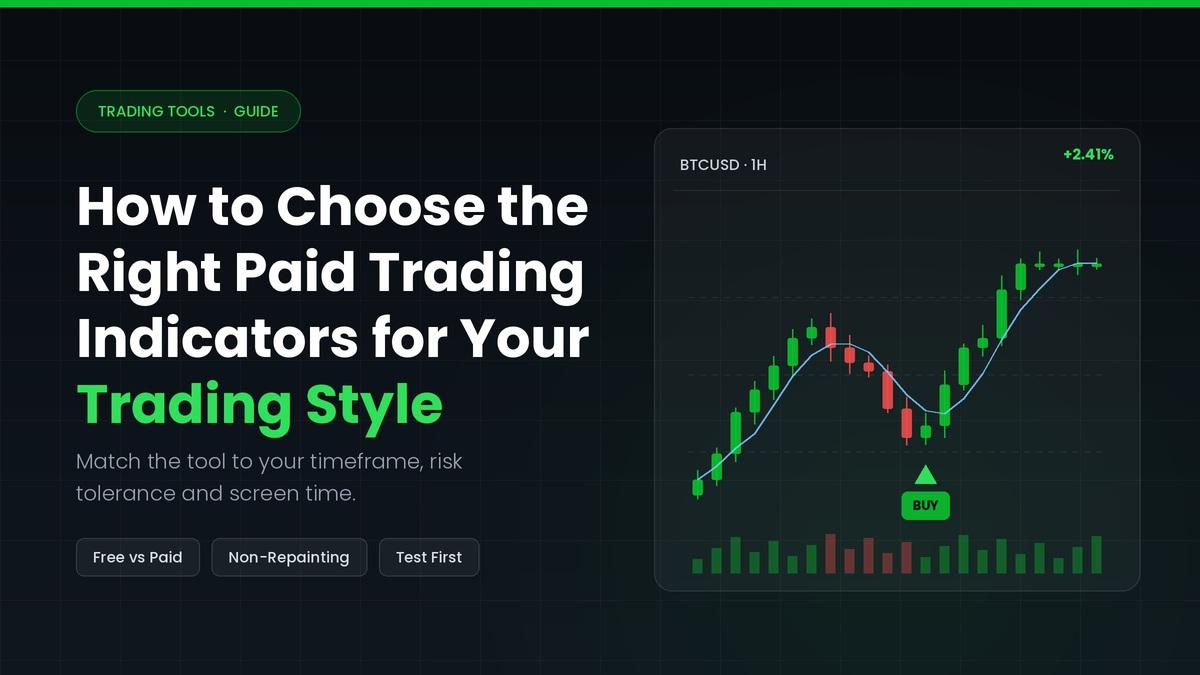
Most traders buy tools before they understand themselves. That order is backwards. After two decades of covering markets and stress-testing hundreds of chart scripts, I can tell you the pattern repeats endlessly. The trader who wins is rarely the one with the busiest chart.
Paid trading indicators can genuinely sharpen an edge. However, they only help when they match how you actually trade. A scalper who buys a slow trend filter will bleed out gradually. Meanwhile, a position trader who buys a one-minute momentum script will bleed out fast.
So let's fix the order. First, define your style. Next, judge the tool against it. Finally, pay only when the evidence supports the purchase.
Start With Your Style, Not the Sales Page
Your trading style is simply the intersection of three things: your holding period, your risk tolerance, and your available screen time.
Be honest about all three. For example, a nurse working twelve-hour shifts cannot scalp the New York open. A student with four free evening hours cannot manage a portfolio of weekly options. Once you accept those limits, the shortlist of useful tools shrinks dramatically.
Ask yourself four quick questions before you shop:
- How long do I usually hold a position?
- How many trades per week do I actually want?
- Which market do I know best?
- Do I prefer trend continuation or mean reversion?
Write the answers down. Afterwards, treat that note as your buying filter. Any indicator that fails the filter gets skipped, no matter how good the marketing looks.
Free vs Paid TradingView Indicators: What Actually Differs
The free vs paid TradingView indicators debate gets emotional fast. Let's keep it practical instead.
Free trading indicators cover the fundamentals extremely well. RSI, MACD, moving averages, VWAP, Bollinger Bands, and volume profile are all built in. Furthermore, thousands of open-source community scripts sit in the public library at zero cost. For learning market structure, that library is more than enough.
Paid trading indicators usually differ in five specific ways.
1. Non-repainting logic. Many free scripts look flawless in hindsight because they redraw signals after the fact. Serious paid tools lock signals on bar close and state that clearly.
2. Integrated confluence. Instead of stacking six separate windows, one paid script may combine trend, momentum, and volatility into a single ruleset.
3. Alert infrastructure. Reliable webhooks, one-shot alerts, and clean message payloads matter enormously for automation.
4. Documentation and support. Good vendors publish settings guides, video walkthroughs, and version notes.
5. Ongoing maintenance. Markets change. Abandoned free scripts do not.
Notice what is missing from that list. Accuracy is not automatically included. Price alone guarantees nothing, which is exactly why the next question deserves a careful answer.
Are Paid Trading Indicators Worth It?
Are paid trading indicators worth it? Sometimes yes, and often no. The answer depends far less on the product than on the buyer.
They tend to be worth it when three conditions are already true.
First, you have a defined strategy with written rules. Second, you know which specific step of that process is weak. Third, the tool addresses that exact weakness. Under those conditions, a paid indicator becomes a targeted upgrade rather than a lottery ticket.
They are rarely worth it when you are still hunting for a strategy. In that situation, the purchase simply postpones the real work. As a result, many traders cycle through a dozen subscriptions and learn nothing.
Now consider the math, because it clarifies everything. Suppose an indicator costs $40 per month and your account holds $2,000. That subscription represents 24% of your capital per year. Therefore the tool must add meaningful, measurable performance just to break even. Conversely, on a $50,000 account the same fee is trivial noise.
Run that calculation before you buy. Honestly, it filters out most impulse purchases on its own.
Subscription or One-Time Purchase?
Pricing structure deserves a moment of thought too. Most paid trading indicators are sold as monthly subscriptions, although lifetime licences do exist.
Subscriptions suit short evaluation periods. You can cancel quickly, and updates arrive automatically. Lifetime access suits tools you already trust, especially when the strategy behind them is timeless rather than trendy.
Either way, avoid annual prepayment until you have traded the tool for a full quarter. Discounts feel appealing, yet flexibility is worth more early on.
Match the Tool to Your Trading Style
Different styles demand fundamentally different behaviour from an indicator. Below are the four common profiles and what each one should prioritise.
Scalpers and Intraday Momentum Traders
Speed and precision matter most here. You need instant signals, tight entry zones, and clear invalidation levels.
Look for order-flow context, session-based levels, and volatility filters that stand down during dead hours. Additionally, confirm that alerts fire on the correct tick and not one bar late. Lagging tools destroy scalping edges quickly, so smoothing settings should stay minimal.
Day Traders
Day traders live between structure and speed. Consequently, the best fit is usually a hybrid: a higher-timeframe bias filter combined with a lower-timeframe trigger.
Prioritise tools that mark opening range, prior-day levels, and liquidity zones. Session awareness is essential too, especially around the London and New York overlap.
In addition, check how the tool behaves on gap days. Many paid trading indicators calculate levels from continuous data and therefore misplace them after a large overnight move.
Swing Traders
Patience changes the requirements completely. Here, signal quality beats signal frequency every single time.
Swing traders should favour trend-following systems, multi-timeframe confirmation, and adaptive stop placement. Moreover, a good swing tool should stay quiet during choppy ranges. Fewer, cleaner alerts genuinely help, because each trade carries more risk and more room.
Position Traders and Investors
Long-horizon traders need macro context rather than trade triggers. Cycle models, relative strength dashboards, and valuation overlays serve this group best.
Frankly, most position traders can skip paid trading indicators entirely. Free trading indicators and solid fundamental research already cover the job.
A Seven-Point Checklist Before You Pay
Use this checklist every time. It was built from years of watching traders overpay for very little.
Most paid trading indicators fail at least one of these points. That is fine, provided the failure is minor and disclosed openly.
- Repainting test. Does the seller confirm, in writing, that signals do not repaint? Vague answers are answers.
- Transparent logic. You do not need the source code. You do need a plain-English explanation of the concept.
- Timeframe fit. Was the tool designed for your timeframe, or merely tolerated on it?
- Trial access. A free trial, demo chart, or refund window should be offered without friction.
- Realistic claims. Any promise above roughly 70% win rate deserves deep suspicion.
- Verifiable proof. Look for third-party verified results, not cherry-picked screenshots.
- Total cost. Add up the subscription, the data feed, and your platform plan together.
Score each item honestly. If a tool fails two or more points, walk away and keep your money.
TradingView Indicators Comparison: How to Test Properly
A fair TradingView indicators comparison requires structure. Random clicking proves nothing, so follow a repeatable process instead.
Step one: fix your variables. Choose one market, one timeframe, and one risk model. Change nothing else during the test.
Step two: replay the chart. Use bar replay and step forward manually. This single habit exposes repainting immediately.
Step three: log every signal. Record entry, stop, target, and outcome in a simple journal. Aim for at least 50 trades before drawing conclusions.
Step four: compare against a free baseline. Test the paid tool head-to-head against a standard setup, such as a 20/50 EMA cross with RSI. If the paid version cannot beat that baseline, the upgrade is not real.
Step five: check across regimes. Include a trending stretch, a choppy stretch, and a volatile news week. Many tools shine in one regime and collapse in another.
Step six: measure the right metrics. Win rate alone misleads. Instead, track expectancy, average risk-reward, maximum drawdown, and the longest losing streak.
That process takes two or three weeks. Nevertheless, it saves far more money than it costs in time.
Warning Signs You Should Never Ignore
Certain patterns show up repeatedly in low-quality offers. Watch for these red flags.
- Screenshots of winners only, with no losing sequences shown
- Countdown timers and permanent "last chance" discounts
- Signals presented as instructions rather than context
- No mention of drawdown anywhere in the material
- Locked scripts with zero conceptual explanation
- Aggressive upselling into copy-trading or managed accounts
Above all, be sceptical of guaranteed profits. No indicator can promise that outcome, because markets remain probabilistic by nature.
Build a Simple Stack, Then Stop Adding
Once you commit to a tool, resist the urge to keep stacking. Three or four indicators can cover almost every decision you need.
A clean stack looks like this: one trend tool, one momentum or timing tool, one volatility or risk tool, and one level-based reference. Anything beyond that usually creates conflict rather than clarity.
Give your chosen setup at least 90 days of consistent use. Meanwhile, keep your journal updated and review it weekly. Discipline and repetition will always outperform tool-hopping.
Remember the wider point as well. Paid trading indicators improve information, not judgement. Position sizing, patience, and consistency still determine your results. Because of this, the best purchase is always the one that supports a plan you already follow.
Frequently Asked Questions
Can free trading indicators be enough on their own? Yes, for many traders. Free tools handle trend, momentum, and volume perfectly well. Paid options mainly save time and reduce chart clutter.
How much should beginners spend? Nothing, for the first six months at least. Learn structure and risk first. Then reassess with real data in hand.
How many indicators should sit on one chart? Three or four at most. Beyond that, signals start contradicting each other and hesitation creeps in. Clarity beats coverage.
Do professionals use paid indicators? Some do, though most rely on custom-built systems and disciplined execution rather than off-the-shelf signals.
Final Thoughts
Choosing the right tool becomes surprisingly simple once your style is defined. Start with your holding period and your available screen time. Then apply the checklist, test properly, and buy only what solves a specific problem. In short, let the process lead, and let the purchase follow.
If you decide that paid trading indicators suit your approach, choose a provider that respects transparency. At GainzAlgo, we build non-repainting tools with clearly documented logic, honest performance expectations, and clean alert support for traders at every timeframe.

 English
 Arabic
 French
 Spanish
 Portuguese
 Deutsch
 Turkish
 Dutch
 Italiano
 Russian
 Romaian
 Portuguese (Brazil)