


Progressive Web Apps for Ecommerce: Are They Still Worth It?
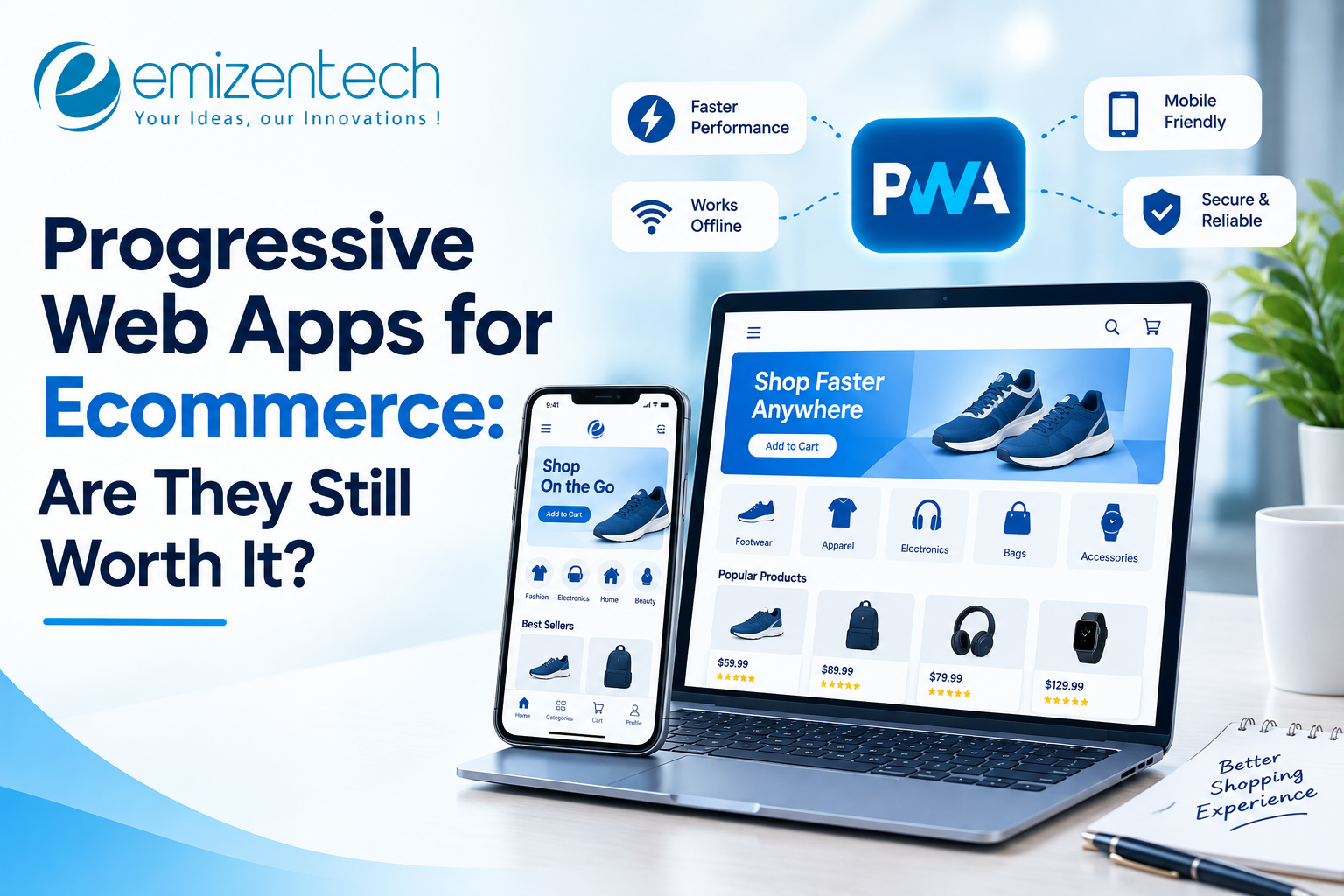
Nobody's shopping expectations are complicated. Load fast. Work on the device in front of them. Don't get in the way of the purchase. Progressive Web Apps showed up promising all of that a few years ago, minus the download, minus the app store detour. The hype cycle on PWAs has come and gone at this point, which is exactly why it's worth revisiting the boring question everyone stopped asking: do they actually still earn their keep in 2026? Here's the honest rundown.
What Is a Progressive Web App (PWA)?
Peel back the terminology, and a PWA is just a website that's learned to act like an app. It still lives entirely in the browser, but it'll sit on a home screen, launch without a typed URL, and keep going even if the connection cuts out for a moment. Two things make that possible. A web app manifest handles how it looks and behaves once someone installs it. A service worker sits in the background managing caching and offline behavior. There's no separate iOS build, no Android build, no app store gatekeeping a launch date, and updates go live the second the underlying site changes. That's really the entire pitch, and it's why ecommerce teams took it seriously in the first place.
Why PWAs Became Popular in Ecommerce
Mobile traffic overtook desktop in ecommerce a while back and never gave the lead up. Most shopping now happens from a phone, often mid-commute, often on a connection that isn't doing anyone any favors. Standard mobile sites weren't built with that in mind, so pages dragged, checkout felt awkward on a small screen, and shoppers bailed the moment things got slow.
PWAs closed that gap without asking anyone to build a full separate app. Local caching plus preloaded resources meant pages transitioned almost instantly, and the experience held up even through a shaky connection. For teams already stretched thin on dev resources, it was a pretty obvious win.
Are PWAs Still Worth It in 2026?
Yes, though the answer comes with more asterisks than it used to.
Browser support finally caught up. Push notifications, background sync, biometric login, all the stuff that used to work inconsistently depending on the platform, now runs across most major browsers. Safari, historically the last to get on board, has closed most of that distance too. Building for Apple devices doesn't feel like settling anymore.
Adoption hasn't kept pace with the hype, though. Plenty of talk, not a lot of follow-through. Only a small percentage of ecommerce sites run a full PWA setup. That's not really a knock on the technology. It just means the ones that did it properly are still ahead of most of the field.
The trade-offs are real, and there's no point pretending they aren't. iOS still restricts background processing and notifications relative to a native app. Some hardware features stay out of reach entirely. And without an app store listing, discovery depends entirely on search visibility and direct traffic showing up on its own.
AI has worked its way into this too. Recommendations, smarter search, conversational shopping, brands are folding all of that into their PWA experiences now, right alongside everything else already running on the storefront.
Where that leaves things: Progressive Web Apps for ecommerce aren't a requirement for every business, but for the ones dealing with real mobile traffic and real performance problems, they're still one of the more affordable fixes available.
Key Benefits of PWAs for Ecommerce
The core reasons to build one haven't shifted much even as the underlying technology has gotten more capable.
Faster Load Speeds
Speed still decides a lot in ecommerce. Caching and background loading shrink how long someone waits to see a product. Faster pages, fewer people leaving early, more people actually browsing past the first click.
Improved Conversion Rates
Cut the friction between browsing and checkout, and more people will finish what they started. It's not a particularly complicated relationship.
Lower Development and Maintenance Costs
One codebase covers both platforms instead of two separate native builds needing their own updates and their own bug fixes. Less overhead for teams already stretched across multiple channels.
Better SEO Performance
Underneath everything, it's still a website, so it gets crawled and indexed the normal way. Solid performance, mobile-friendliness, and decent Core Web Vitals scores still do the heavy lifting for search visibility.
Improved Customer Retention
Push notifications are a low-cost way to bring someone back after they've wandered off, whether that's an order update, a recommendation, or an offer worth acting on. It's a small nudge, but it works often enough to matter.
Real-World Examples of PWAs Paying Off
A handful of recognizable brands have already tested this out, for fairly different reasons, and the results line up more than they conflict.
Alibaba built a PWA for faster mobile shopping and picked up real gains in engagement and conversions.
Trivago pushed load times under 1.5 seconds, which lifted interaction and click-through rates noticeably.
Twitter Lite went lightweight and ended up with more pages viewed per session and less mobile bounce.
Starbucks shipped a PWA using a fraction of the storage its native app needs, and customers can still browse and order even on a weak connection.
The thread running through all of them is straightforward: the PWAs that worked solved actual problems, speed, access, convenience, instead of existing just to say the box got checked.
Where the PWA Work Actually Lives
A PWA doesn't sit off in its own corner. The service worker, the caching layer, the way products load, none of it works without touching the same checkout flow, product catalog, and backend APIs that already run the store. That overlap is exactly why most teams don't treat a PWA build as a side project. It usually gets folded into whoever's already handling the storefront, which in practice means it falls under the same ecommerce development services doing everything else, handled by a development team that's already built and maintained that same storefront across platforms like Shopify, Magento, and WooCommerce for years. That kind of hands-on experience matters here, since a team that already knows where the catalog, checkout, and integrations live can slot a PWA in without breaking any of it, instead of a separate team having to reverse-engineer how the existing site works before touching anything.
Is a PWA Right for Your Ecommerce Business?
Not everyone needs one, and it's worth saying that outright. A PWA can genuinely move the needle on mobile performance and user experience, but whether it's worth the investment depends on your traffic, your goals, and what's already running. Better to confirm it's solving something real before committing time to it, rather than assuming it's automatically the right call.
Probably a good fit if:
-
Most of your traffic is mobile
-
Load times are slow or bounce rates are high
-
Mobile conversions need improvement
-
Your users regularly deal with unreliable internet
-
Native app development is outside your budget
Maybe skip it if:
-
Your existing native app already works well
-
App-store visibility matters for how you grow
-
Certain advanced device features are non-negotiable
-
Your current mobile site already performs fine
Worth asking before committing:
-
How much of your traffic is actually mobile?
-
Are performance problems genuinely costing you conversions?
-
Can native app development fit the budget right now?
-
Would a faster mobile experience actually move revenue?
Whichever way those answers lean, they should make the decision a lot clearer.
Conclusion
PWAs have lost their novelty, but that's different from losing their usefulness, it just means fewer people are writing exciting think-pieces about them. For businesses dealing with slow mobile pages, tight development budgets, or growth in areas with unreliable connectivity, a PWA still holds up as a practical middle ground between a basic website and a full native app. Native apps still make more sense for brands leaning heavily on loyalty programs or device-specific features, so the real decision comes down to actual business needs rather than which option sounds more current. At EmizenTech, a mobile app development company, we've seen this play out often enough to say PWAs remain a sound choice in 2026, provided they're built for the right reasons and matched to the right kind of business.
FAQs
1. Are Progressive Web Apps still relevant for ecommerce in 2026?
Largely, yes. Browser support has improved a lot, and PWAs still address real problems around mobile speed and accessibility, even though industry-wide adoption hasn't caught up with the interest.
2. Do PWAs actually improve conversion rates?
In many documented cases, yes. Faster load times and smoother browsing tend to reduce cart abandonment and hold attention a bit longer.
3. Is a PWA cheaper than building a native app?
Typically. One codebase across devices generally costs less to build and maintain than separate iOS and Android apps.
4. Do PWAs work properly on iPhone and Safari?
Considerably better than before, though background processing and notifications still behave somewhat differently than on Android.
5. Are PWAs good for SEO?
Yes, since they remain standard websites underneath. They get indexed normally and benefit from the same performance-driven ranking factors as any other site.

 English
 Arabic
 French
 Spanish
 Portuguese
 Deutsch
 Turkish
 Dutch
 Italiano
 Romaian
 Portuguese (Brazil)
 Greek