


Mini-split or central air: an honest comparison for a Florida house
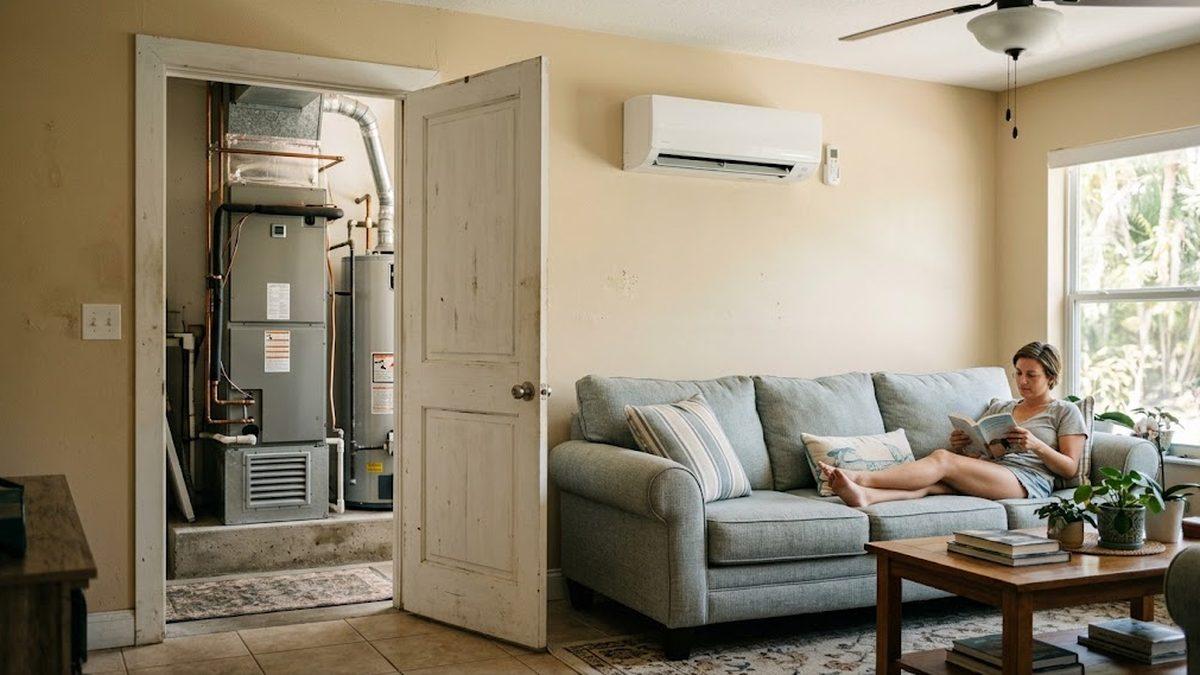
Mini-split or central air: an honest comparison for a Florida house
Ductless equipment is often presented as the modern replacement for central air conditioning. It is better at some things, worse at others, and in most Florida houses the deciding factor turns out to be the state of the existing ductwork rather than any property of the equipment.
The mechanical difference
A central system has one large indoor unit connected to every room by ducts. One compressor, one blower, one thermostat, one temperature for the whole house. Air is cooled in one place and distributed.
A ductless system has an outdoor compressor connected by refrigerant lines to one or more indoor heads mounted in the rooms themselves. Each head cools the air in front of it. Nothing is distributed; the cooling happens where it is needed.
The consequence that matters most is what happens to the air in between. In a central system, ducts commonly run through an attic that reaches well above 120 °F on a summer afternoon. Leakage and conduction losses in that environment are real, and in older Florida housing stock they can account for a substantial share of the system's output. Ductless equipment has no ducts to lose anything in, and that is the single largest source of its efficiency advantage in practice.
Where ductless genuinely wins
Zoning. Each head is independently controlled. A bedroom at 70 for sleeping and a rarely used guest room at 80 is trivial for ductless and effectively impossible for a single-zone central system.
Additions and difficult rooms. A garage, an enclosed lanai, a converted attic, an accessory dwelling. Anywhere ducts do not go and could not sensibly be added, ductless is not merely better, it is the only reasonable answer.
Part-load efficiency. Inverter-driven compressors modulate output continuously rather than cycling on and off at full capacity. Most of the time a house needs part of the system's capacity, and matching output to that demand is where efficiency actually accumulates.
No duct losses. Worth restating because it is the biggest number in the comparison, and it is entirely a function of how bad the existing ducts are.
Redundancy. With four heads, one failure leaves three rooms cool. When a central system fails, the whole house is out.
Where central still wins
Whole-house cost. Replacing a central system with a comparable central system is generally less expensive than fitting enough ductless heads to serve every room, particularly when the ducts are serviceable and can simply be reused.
Filtration and ventilation. A central return pulls air from the house through a single filter, which is where media filtration, UV treatment or a whole-house dehumidifier get installed. Ductless heads have small washable filters and no practical place to add anything, so improving air quality in a fully ductless house means a separate system.
Appearance. A wall head is visible. Ceiling cassettes and slim ducted heads reduce that, at additional cost. Some people never notice; others cannot stop noticing.
Even conditions. A central system continuously mixes the air in the house, so temperature and humidity stay reasonably uniform. Ductless conditions the rooms with heads in them, and a hallway or bathroom without one drifts.
Maintenance access. One filter and one coil versus one filter and one coil per head. With five heads that is five sets of cleaning, and in this climate the indoor coils and blower wheels of ductless heads need it.
| Ductless | Central | |
|---|---|---|
| Duct losses | None | Significant if ducts are in an attic |
| Zoning | Built in | Requires dampers and controls |
| Whole-house install cost | Higher | Lower where ducts exist |
| Filtration options | Limited | Extensive |
| Indoor appearance | Visible heads | Registers only |
| Maintenance points | One per head | One |
| Failure impact | One room | Whole house |
| Humidity control | Good if sized right, poor if oversized | Good if sized right, poor if oversized |
The question that usually settles it
Before comparing equipment, find out what the existing ducts are doing. A duct leakage test puts a number on it, and the number changes the decision. Ducts in good condition are a large asset already paid for, and replacing a central system that uses them is the economical path. Ducts leaking a quarter of their air into a 130 °F attic are a liability, and at that point the comparison is not ductless against central, it is ductless against central plus duct replacement.
Duct replacement in an existing Florida house is disruptive and not cheap. Once it is in the total, ductless often becomes competitive on cost as well as on efficiency, which is why the same house can honestly receive opposite recommendations from two contractors who assessed the ducts differently.
Ask for the leakage figure. If nobody measured it, the recommendation rests on an assumption, whichever direction it points.
Reading the efficiency numbers honestly
Ductless equipment reaches efficiency ratings that central systems rarely match, and those numbers get quoted heavily in sales conversations. They are real laboratory results and they are not what your house will deliver, for reasons worth understanding before they anchor a decision.
Ratings are measured on a matched pair under controlled conditions. A multi-zone outdoor unit connected to four heads of assorted sizes performs below the headline figure, sometimes well below, because the combination is no longer the one that was tested. Manufacturers publish ratings for specific combinations, and asking for the rating of the exact configuration being quoted is a fair question with a precise answer.
The comparison also has a floor set by regulation rather than by marketing. New split systems under 45,000 BTU sold in the Southeast must meet at least 14.3 SEER2, so the gap is between a modern central system and a modern ductless one, not between ductless and the fifteen-year-old unit currently in the yard. Much of the improvement people attribute to going ductless is simply the improvement from replacing old equipment with new.
Where the ductless advantage is genuine and hard to argue with is the part no rating captures: air that never travels through a hot attic. That saving does not appear in the SEER2 figure of either system, because the test does not include your ductwork.
The hybrid answer, which is often the right one
These are not exclusive choices, and the most sensible outcome in many houses is both. Keep the central system for the main living areas where the ducts already run reasonably well, and add ductless heads for the spaces the ducts never served: the garage workshop, the converted lanai, the room over the garage, the primary bedroom that has always run warmer than the rest of the house.
That approach spends money only where the existing system genuinely fails, rather than replacing everything to solve a problem confined to two rooms. It also spreads the expense across years rather than a single project. Contractors who handle both, rather than specialising in one, tend to give more useful advice here, and any firm quoting ductless mini-split installation in Sarasota should be willing to tell you when the ducted system you already own is the better place to put the money.
The humidity caveat
One warning that applies to both and matters more here than almost anywhere. Oversized equipment dehumidifies badly, because moisture removal happens gradually over a long run and an oversized system does not run long. Inverter-driven ductless equipment handles this better than fixed-speed central equipment, but only within its modulation range: below its minimum output it cycles like anything else.
The practical failure mode is a multi-zone ductless system where every head was sized generously "for the hot days". On a mild day each head runs at minimum, satisfies its room in minutes, and stops. Temperature is fine and the house sits at 65 percent relative humidity. Correct sizing, room by room, is what prevents it, and it is the step most often skipped.
Frequently asked questions
Are mini-splits noticeably quieter?
Indoors, usually yes, because the compressor and the largest blower are outside. Outdoors it depends on the equipment. The relevant question is where the outdoor unit sits relative to bedroom windows, for either type.
Do ductless systems heat as well as cool?
Almost all of them are heat pumps and reverse for heating, which comfortably covers a Southwest Florida winter. Cold-climate performance ratings matter elsewhere and are close to irrelevant here.
Can I add a ductless head to a house that already has central air?
Yes, and it is the most common installation there is. The two systems are independent, though thermostats should be set so they are not fighting each other across an open doorway.
Is a whole-house ductless retrofit worth it?
Sometimes, most often where the ductwork is failing anyway, where the house has rooms with genuinely different needs, or where there is no attic or crawl space to run ducts through. Where good ducts already exist, the case is much weaker.
Current as of September 2026.

 English
 Arabic
 French
 Spanish
 Portuguese
 Deutsch
 Dutch
 Italiano
 Russian
 Romaian
 Portuguese (Brazil)
 Greek