


React Native Development Services vs. Hybrid App Services
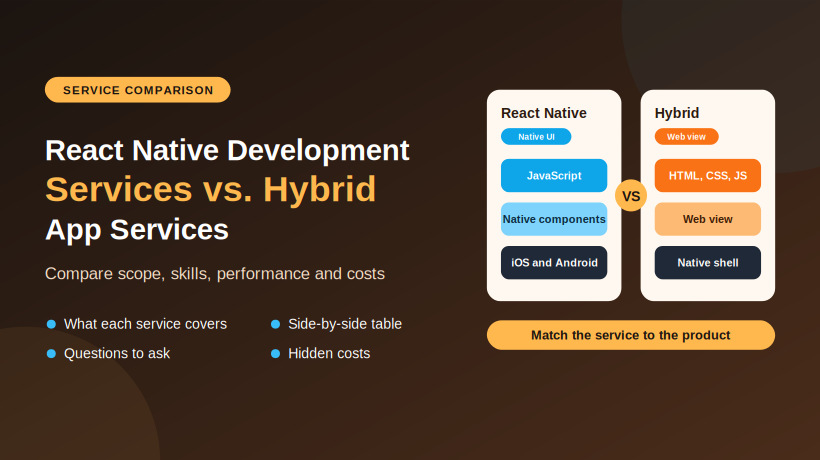
Quick answer first: React Native builds screens from real native components and suits most mobile-first products, while hybrid apps run web technology inside a native shell and suit web-first, content-driven apps. The details, however, shape your budget, your timeline, and your users' experience. Those users are demanding, since Sensor Tower's State of Mobile 2026 report found that people spent about 3.6 hours a day in apps and used roughly 34 different apps each month. With so many choices on their phones, users quickly drop apps that feel slow or clumsy. This guide compares both types of providers in plain language, so you can choose with confidence.
What You Are Really Buying With Each Service
Both options fall under cross-platform app development services, which means one team builds for iOS and Android together. The difference is in the building blocks. A React Native team writes JavaScript or TypeScript and displays real native interface elements, so the app behaves much like one built separately for each platform. A hybrid team builds with HTML, CSS, and JavaScript, then wraps the result in a native container, often with tools such as Ionic and Capacitor. As a result, the first approach usually focuses on mobile-first products, while the second often focuses on bringing existing web experiences to the app stores.
Side-by-Side: Where the Two Services Differ
This table highlights the differences that matter most when you compare providers:
| Factor | React Native services | Hybrid app services |
|---|---|---|
| Core technology | JavaScript or TypeScript with React | HTML, CSS, and JavaScript in a native shell |
| Interface | Native UI components | Web view inside the app |
| Performance | Closer to native for interactive screens | Good for content and forms, less ideal for heavy animation |
| Web code reuse | Limited | High |
| Typical team skills | React and mobile experience | Web development experience |
| Best for | Consumer-facing, mobile-first apps | Internal tools and web-first products |
Questions to Ask Any Provider Before You Sign
Whether you are talking to a React Native team or a provider of hybrid app development services, these questions reveal how reliable they really are:
- Have you built similar apps? Ask for examples that match your industry and complexity.
- How do you handle device features? Find out how they add cameras, payments, or notifications when a ready-made plugin is missing.
- How do you test? Look for testing on real iOS and Android devices, not only on simulators.
- Who maintains the app after launch? Clarify support, updates, and response times in writing.
- Who owns the code? Confirm ownership, documentation, and handover terms before work begins.
Which Service Fits Which Project?
Choose a React Native team when:
- Your product is mobile-first and needs a smooth, native-feeling experience.
- The app includes gestures, animations, or frequent screen transitions.
- You plan to keep growing the app over several years.
Choose a hybrid team when:
- You already have a web app that you want to publish in the app stores.
- The app is mostly forms, dashboards, or content.
- Your priority is a quick launch with a limited budget.
The Hidden Costs Nobody Mentions Upfront
The cheapest mobile app development solution at launch is not always the cheapest after two years. Operating system updates, plugin changes, and performance fixes all add ongoing work, and these costs vary by approach. For that reason, ask each provider for an estimate that covers maintenance as well as the initial build, so you can compare the full picture.
Final Thoughts: Match the Service to the Product
Choosing between React Native development services and hybrid options is less about which technology is better and more about what your product needs. Mobile-first apps with rich interactions usually lean toward React Native, while web-first products can move faster with a hybrid approach. Start with your users, your team, and your long-term plans, and compare providers on experience and support, not only on price.
Frequently Asked Questions
1. Is React Native a hybrid framework?
Not in the traditional sense. React Native renders native components, while classic hybrid apps run inside a web view, although some people use the word hybrid loosely for both.
2. Which approach costs less?
Hybrid can cost less when you can reuse an existing web app. For a new mobile-first product, the difference is smaller, so compare full costs including maintenance.
3. Are hybrid apps slower?
For simple, content-based apps, users rarely notice a difference. Heavy animation and complex interactions are where hybrid apps are more likely to feel less smooth.
4. Can I switch approaches later?
Yes, but it usually means rebuilding parts of the app, so planning for your long-term needs early can save time and money.
5. How do I choose a reliable provider?
Check relevant case studies, ask about testing and maintenance, and confirm code ownership in writing before you sign.

 English
 Arabic
 French
 Spanish
 Portuguese
 Deutsch
 Turkish
 Dutch
 Italiano
 Romaian
 Portuguese (Brazil)
 Greek