


Outsource Medical Coding Services: Improve Accuracy, Compliance, and Revenue Cycle Efficiency
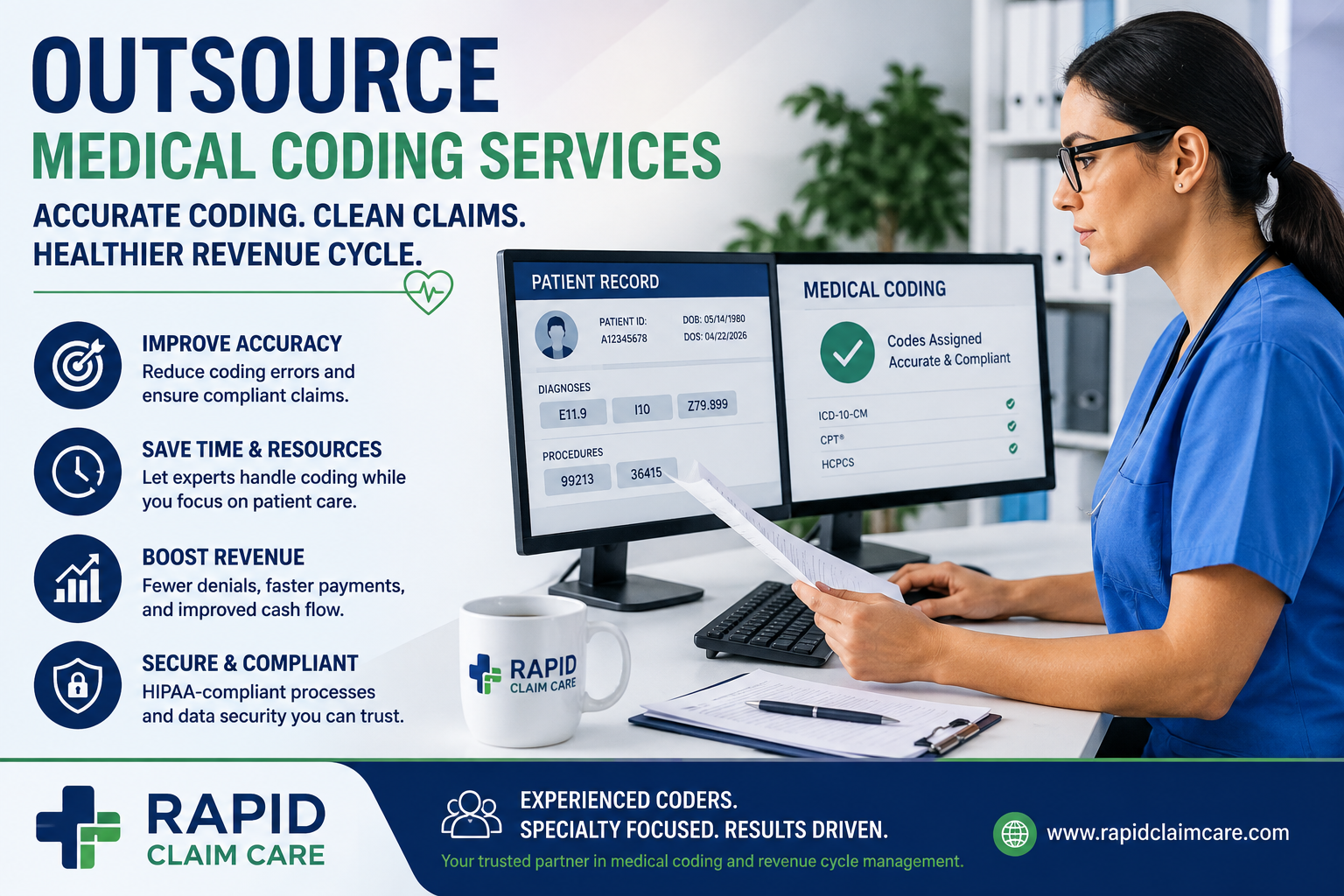
Medical coding is one of the most important parts of the healthcare revenue cycle. Every patient encounter generates clinical information that must be translated into accurate diagnosis and procedure codes before claims can be submitted to payers.
For busy healthcare practices, managing this process internally can become challenging. Physician practices, hospitals, specialty clinics, and other healthcare organizations may face growing documentation requirements, staffing shortages, coding complexity, and the need to keep up with changing coding guidelines.
That is why many organizations choose to outsource medical coding services to experienced professionals.
Outsourcing can provide access to trained medical coders while helping healthcare organizations manage workloads, improve coding accuracy, support cleaner claims, and reduce the administrative burden on internal teams.
According to the FY 2026 ICD-10-CM Official Guidelines, accurate coding depends heavily on complete and consistent documentation, and the provider and coder have important roles in achieving accurate reporting.
What Are Outsourced Medical Coding Services?
Outsourced medical coding services involve hiring an external medical coding company or specialized healthcare service provider to handle some or all of an organization's coding work.
Instead of maintaining a large in-house coding department, a healthcare practice can work with an external team that reviews medical documentation and assigns appropriate codes according to applicable coding rules.
Depending on the provider and practice requirements, outsourced medical coding may include:
-
ICD-10-CM diagnosis coding
-
CPT procedure coding
-
HCPCS coding
-
Outpatient medical coding
-
Inpatient coding
-
Specialty-specific coding
-
Evaluation and management coding
-
Chart review
-
Coding audits
-
Documentation review
-
Coding quality assurance
The exact services depend on the healthcare organization's specialty, payer mix, documentation practices, and revenue cycle needs.
Why Do Healthcare Practices Outsource Medical Coding?
Medical coding requires specialized knowledge and attention to detail. Coding teams must understand clinical documentation, coding conventions, payer requirements, and current code sets.
The CDC's National Center for Health Statistics maintains the U.S. ICD-10-CM system and publishes annual code-set updates. The FY 2026 release includes updates that apply during the relevant fiscal-year periods, making it important for coding teams to work with current resources.
For healthcare practices, keeping an internal team trained and fully staffed can require significant time and resources.
Outsourcing can provide an alternative.
1. Access to Specialized Coding Expertise
A reputable outsourcing partner can provide trained coders who understand different coding environments and specialties.
This can be especially useful for practices dealing with complex documentation or multiple specialties.
Depending on the organization's needs, specialized coding support may cover areas such as:
-
Cardiology
-
Orthopedics
-
Oncology
-
Gastroenterology
-
Emergency medicine
-
Primary care
-
Dermatology
-
Behavioral health
-
Surgery
Specialty-specific experience can help coders understand the terminology, procedures, and documentation patterns associated with different clinical settings.
2. Improve Coding Accuracy
Accurate coding is essential to appropriate claim submission and reporting.
The official ICD-10-CM guidelines state that the entire medical record should be reviewed to determine the specific reason for an encounter and the conditions treated. They also emphasize that complete documentation is essential for accurate coding.
An experienced coding team can review documentation systematically and identify coding issues before they affect the claims process.
Better coding processes can help practices reduce problems such as:
-
Incorrect diagnosis codes
-
Incorrect procedure codes
-
Missing codes
-
Unsupported codes
-
Coding inconsistencies
-
Documentation-related issues
-
Avoidable claim delays
However, outsourcing does not automatically guarantee perfect coding or reimbursement. Results depend on documentation quality, payer rules, workflow, and the quality of the coding process.
3. Reduce the Administrative Burden
Healthcare providers already manage patient care, documentation, staffing, scheduling, compliance, and other operational responsibilities.
Medical coding adds another specialized administrative requirement.
By choosing to outsource medical coding services, practices can shift part of this workload to an external team while allowing internal employees to focus on other priorities.
For smaller practices, this can be particularly useful when hiring and maintaining a full-time coding department is difficult.
4. Support a More Efficient Revenue Cycle
Medical coding is closely connected to billing and claims processing.
Coding errors can contribute to claim problems, delays, and additional administrative work. The AMA notes that coding and billing errors can contribute to unpaid claims and highlights coding accuracy and clean claim submission as important revenue-cycle performance areas.
A well-managed coding process can support the revenue cycle by helping ensure that claims are based on appropriate and properly documented codes.
The goal is not simply to submit more claims.
The goal is to submit accurate, properly supported claims.
5. Scale Coding Capacity When Your Practice Grows
A practice's coding workload can change quickly.
New providers, increased patient volume, new specialties, seasonal demand, or acquisitions can create additional coding requirements.
Hiring permanent staff every time the workload increases may not be practical.
Outsourcing gives organizations the opportunity to increase or decrease coding support according to operational needs.
This scalability can be especially valuable for growing healthcare organizations.
In-House vs. Outsourced Medical Coding
Healthcare organizations often ask whether they should keep coding internally or outsource the function.
There is no single answer for every organization.
| Factor | In-House Coding | Outsourced Coding |
|---|---|---|
| Staffing | Practice manages recruitment | Provider supplies coding resources |
| Training | Internal responsibility | Outsourcing partner manages training |
| Scalability | May require additional hiring | Capacity can often be adjusted |
| Management | Direct internal oversight | Requires vendor management |
| Specialized expertise | Depends on internal staff | Can provide access to specialists |
| Technology | Practice manages systems | Provider may supply supporting technology |
| Cost structure | Employee-based | Service-based |
| Quality monitoring | Internal responsibility | Should be defined in vendor agreement |
The right choice depends on coding volume, specialty complexity, budget, staffing, technology, and organizational goals.
Some organizations may also choose a hybrid model, keeping certain coding functions in-house while outsourcing overflow, specialty coding, audits, or other services.
What Medical Coding Services Can You Outsource?
Not every organization needs the same type of coding support.
A provider may outsource its entire coding operation or only selected functions.
Outpatient Coding
Outpatient coding supports physician offices, clinics, ambulatory facilities, and other outpatient healthcare settings.
It may involve reviewing documentation and assigning appropriate diagnosis and procedure codes based on the services provided.
Inpatient Coding
Hospitals and inpatient facilities may require more complex coding workflows involving diagnoses, procedures, documentation, and inpatient-specific coding requirements.
E/M Coding
Evaluation and management coding requires careful review of documentation and the applicable coding requirements.
A specialized coding team can help practices review E/M documentation and identify potential coding issues.
Specialty Medical Coding
Specialty coding can be useful for organizations with complex or highly specialized clinical services.
A qualified coding partner should be able to demonstrate experience relevant to your specialty rather than simply offering generic coding support.
Medical Coding Audits
Coding audits can help identify patterns of inaccurate, inconsistent, incomplete, or unsupported coding.
Regular audits can also help organizations identify training opportunities and improve internal processes.
How to Choose the Right Medical Coding Outsourcing Company
Choosing a coding partner is an important business decision.
The cheapest provider is not necessarily the best provider.
Before signing an agreement, evaluate several factors.
1. Coding Experience
Ask how long the company has provided medical coding services and whether its coders have experience with your specialty and care setting.
2. Qualified Coding Professionals
Ask about coder credentials, training, continuing education, quality assurance, and supervisory processes.
Professional coding organizations such as AAPC provide medical coding, auditing, and revenue-cycle resources and recognize the importance of specialized expertise in these areas.
3. Quality Assurance
Ask how coding accuracy is measured.
A strong provider should have a defined quality-review process rather than simply counting completed charts.
Useful performance indicators may include:
-
Coding accuracy
-
Productivity
-
Turnaround time
-
Error rates
-
Audit results
-
Query rates
-
Denial trends
4. Data Security and HIPAA Considerations
Medical records contain sensitive patient information.
Before outsourcing, healthcare organizations should carefully evaluate how a vendor protects protected health information, controls access, manages data transmission, and handles security incidents.
The business associate relationship and applicable HIPAA requirements should be addressed appropriately in the contractual arrangement.
5. Turnaround Time
Ask how quickly charts will be coded and what happens when volume increases.
Turnaround expectations should be clearly documented in the service agreement.
6. Reporting and Transparency
A good outsourcing partner should provide meaningful reports rather than simply sending completed charts.
Regular reporting can help healthcare organizations understand coding performance and identify areas that require improvement.
How Outsourcing Medical Coding Can Help Reduce Claim Problems
Claims can encounter problems for many reasons, including coding issues, documentation gaps, payer requirements, medical necessity concerns, and administrative errors.
Coding is therefore one part of a much larger claims process.
The AMA recommends monitoring revenue-cycle measures such as coding accuracy, missed charges, clean claim submission, and denial-related performance.
Outsourced coding can support this process by helping identify coding problems before claims are submitted.
For example, a coding review may identify:
-
Diagnosis and procedure mismatches
-
Missing documentation
-
Incorrect code selection
-
Incomplete coding
-
Incorrect sequencing
-
Unsupported services
-
Potential documentation queries
The objective is to improve the quality of the claim before it reaches the payer.
When Should a Healthcare Practice Outsource Medical Coding?
Outsourcing may be worth considering when:
-
Coding volume has increased
-
Your internal coding team is understaffed
-
You are experiencing coding backlogs
-
Specialty coding has become more complex
-
Your practice is expanding
-
Internal hiring is difficult
-
Coding quality requires improvement
-
You need temporary coding support
-
You want to reduce administrative workload
-
You need additional audit or quality-review capacity
It may also make sense when a practice wants to focus internal resources on patient care and core operations.
Common Mistakes to Avoid When Outsourcing Medical Coding
Outsourcing can provide significant operational benefits, but choosing the wrong partner can create new problems.
Choosing Based Only on Price
A low-cost vendor may not provide the expertise, quality controls, communication, or specialty knowledge your organization needs.
Compare total value rather than hourly or per-chart price alone.
Ignoring Specialty Experience
A cardiology practice and a dermatology practice may have very different coding requirements.
Ask whether the vendor has demonstrated experience with your clinical specialty.
Failing to Define Performance Expectations
Your contract should clearly establish expectations for:
-
Accuracy
-
Turnaround time
-
Communication
-
Reporting
-
Security
-
Escalation procedures
-
Quality reviews
Treating Coding as Separate From Documentation
Accurate coding depends on accurate documentation.
The FY 2026 ICD-10-CM guidelines emphasize that complete documentation is essential to accurate coding.
If documentation is incomplete, even a highly qualified coder may not have enough information to assign the most appropriate code.
Why Choose Rapid Claim Care for Medical Coding Services?
At Rapid Claim Care, we understand that medical coding is more than entering codes into a billing system.
Accurate coding supports the larger revenue cycle and helps healthcare organizations maintain organized, compliant, and efficient claims workflows.
Our medical coding services are designed to support healthcare practices that need reliable coding expertise without the administrative burden of building and managing a large internal coding operation.
We focus on:
-
Accurate medical coding
-
Experienced coding support
-
Specialty-specific workflows
-
Quality assurance
-
Timely turnaround
-
Documentation review
-
Revenue-cycle support
-
Scalable solutions
Whether you need ongoing coding support, help managing increased volume, or additional expertise for a growing practice, outsourcing can provide a practical way to strengthen your coding workflow.
Frequently Asked Questions About Outsourcing Medical Coding
What does it mean to outsource medical coding services?
It means hiring an external company or specialized coding team to review medical documentation and assign appropriate diagnosis and procedure codes instead of handling all coding internally.
Is outsourcing medical coding worth it?
It can be, particularly for practices dealing with high coding volumes, staffing shortages, specialty complexity, or coding backlogs. The value depends on the provider's quality, pricing, expertise, and ability to meet your organization's needs.
What are the benefits of outsourcing medical coding?
Common benefits include access to specialized expertise, scalable staffing, reduced administrative workload, quality monitoring, and support for more efficient revenue-cycle processes.
Can small medical practices outsource coding?
Yes. Outsourcing can be particularly useful for smaller practices that do not have enough coding volume or resources to maintain a dedicated internal coding department.
How do I choose a medical coding outsourcing company?
Evaluate the provider's coding expertise, specialty experience, coder qualifications, quality-assurance program, turnaround times, security practices, reporting, communication, and pricing.
Does outsourcing guarantee fewer claim denials?
No. Outsourced coding cannot guarantee a specific denial rate or reimbursement result. Claims depend on coding, documentation, payer policies, medical necessity, eligibility, authorization, and other factors.
Improve Your Coding Workflow With Rapid Claim Care
Medical coding is a critical part of a healthcare organization's revenue cycle. When coding is inaccurate, delayed, or inconsistent, the effects can extend beyond the coding department and create additional work throughout the claims process.
Choosing to outsource medical coding services can give healthcare organizations access to specialized expertise, scalable support, and structured quality processes without the challenges of managing every coding function internally.
The right outsourcing partner should become an extension of your revenue-cycle team—not simply another vendor.
At Rapid Claim Care, our goal is to help healthcare organizations simplify medical coding, improve workflow efficiency, and keep their revenue cycle moving.
Focus on your patients. Let Rapid Claim Care support your medical coding.

 English
 Arabic
 French
 Spanish
 Portuguese
 Deutsch
 Turkish
 Italiano
 Russian
 Romaian
 Portuguese (Brazil)
 Greek