


What Tools Help Understand How People Feel While Using My App?
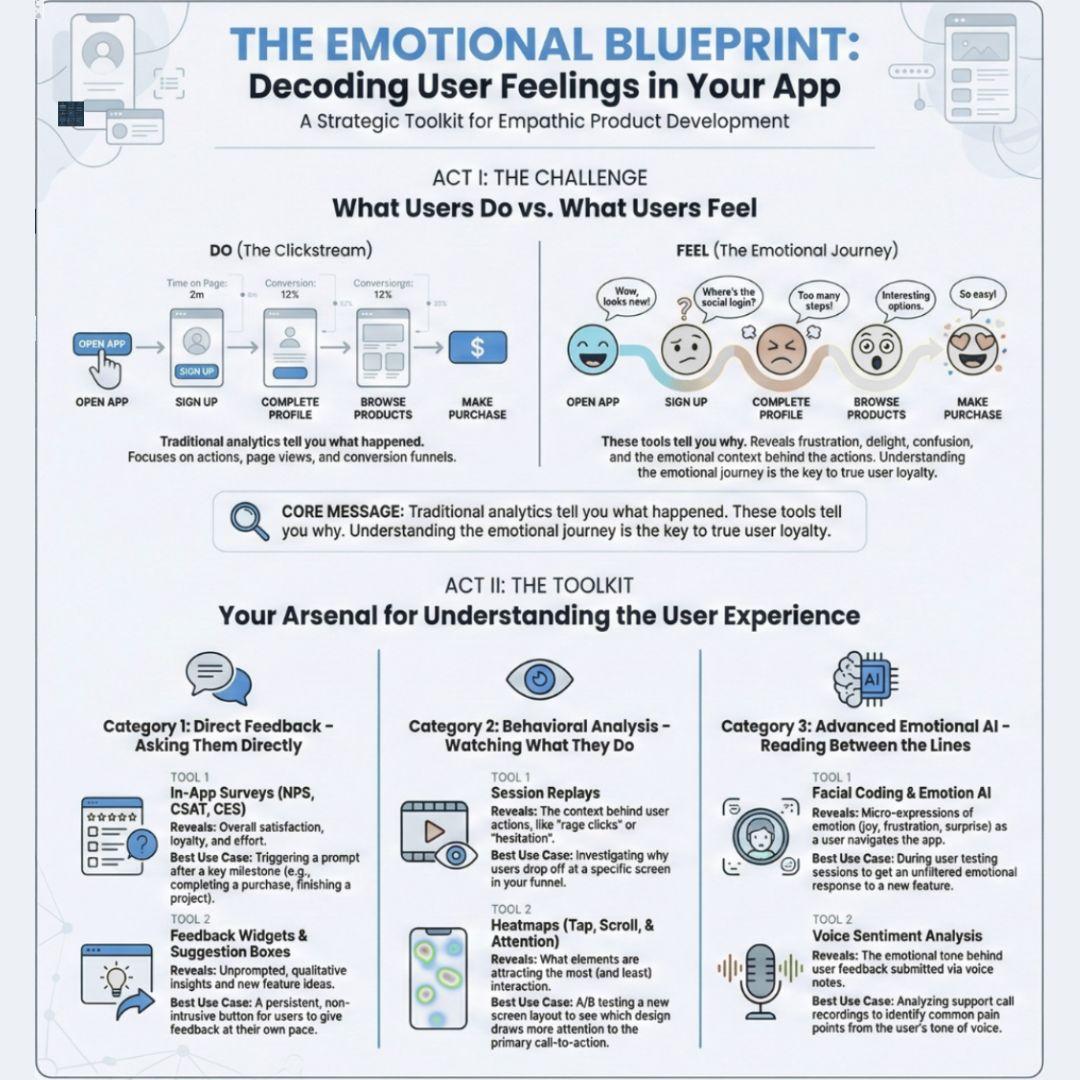
Understanding how people feel while using an app is becoming just as important as understanding what they do. Users make decisions not only through logic but also through emotional responses: frustration, curiosity, hesitation, satisfaction, or confidence. These reactions influence how they navigate, how long they stay, and whether they return. Yet most of these feelings remain invisible in traditional analytics, which track actions but not emotional states.
To address this gap, a new generation of tools helps teams observe emotional signals, interpret subtle reactions, and uncover how people genuinely experience an app. These tools bring depth to UX research, enabling designers to build digital journeys that feel clearer, calmer, and more human.
Why Understanding Emotion Matters in App Interaction
Every interaction carries an emotional layer. Even small moments a confusing button, an unexpected error, or a smooth transition shape overall perception. When users struggle, they often don’t report it; they simply leave. When they enjoy a flow, they might not consciously mention it, but they return because the experience felt right.
Emotional understanding helps teams:
-
Spot friction that wouldn’t appear in standard analytics
-
Identify stress points in navigation
-
Understand where users hesitate or feel lost
-
Strengthen trust by reducing confusion
-
Enhance engagement through smoother flows
Emotions guide choices, and recognizing them leads to more informed design decisions.
The Role of Emotion AI in Emotional Interpretation
One key technology making emotional understanding more accessible is emotion AI. This tool interprets small behavioural cues facial tension, micro-expressions, changes in gaze, or subtle behavioural pauses that reveal how users react during interactions. Because these signals occur in real time, the insights are immediate and accurate.
With careful use during testing sessions, emotion AI helps teams recognise:
-
When an interface element triggers frustration
-
Moments when a task feels easier than expected
-
Positive reactions to visuals, messages, or transitions
-
Hesitation before completing important actions
These insights extend beyond surface-level behaviour and reveal how users process tasks at an emotional level.
Facial Coding Tools for Expression-Based Understanding
Facial coding tools have become a reliable method for understanding emotional reactions. These tools analyze small facial muscle movements to identify emotional states such as interest, confusion, delight, or tension.
They help teams determine:
-
Which screens evoke positive engagement
-
Which instructions cause frustration or doubt
-
Whether visuals support clarity or create distraction
-
Where users experience cognitive overload
By mapping emotional responses across different points in the journey, facial coding creates a more complete emotional profile of the experience.
Eye Tracking Tools for Visual Attention and Emotional Clarity
Visual patterns also reflect emotional states. Eye-tracking tools measure where users look, how long they focus, and which elements they skip. Attention patterns often reveal ease, curiosity, or confusion.
These tools help identify:
-
If a call-to-action is hard to notice
-
Whether visual layout supports natural scanning
-
If users search too long for essential elements
-
Whether cluttered screens increase cognitive strain
Visual attention often correlates with emotional comfort. When users move smoothly across a design, it indicates clarity; when patterns become erratic, it suggests uncertainty.
Voice and Tone Analysis Tools
In some usability sessions, users talk through their actions. Voice analysis tools capture shifts in tone, pace, and hesitation. Even slight changes in voice can reveal stress, uncertainty, or confidence.
These tools are helpful for:
-
Identifying moments when users feel pressured
-
Recognizing relief after completing difficult steps
-
Understanding where instructions feel unclear
-
Detecting excitement when users discover helpful features
Although not used in every session, voice analysis adds an insightful emotional layer when available.
Behavioral Pattern Analysis Tools
Behavior alone can reveal underlying emotions. Interaction pattern tools examine how people move through an app and interpret reactions based on behavior rather than expression.
They analyze:
-
Repeated taps on the same area (often frustration)
-
Rapid swiping or scrolling
-
Sudden exits from a screen
-
Pauses that indicate uncertainty
-
Smooth, continuous movements that reflect comfort
This method is especially valuable when direct emotional data (like facial cues) is unavailable.
In-App Feedback Tools for Immediate Reactions
Quick feedback widgets remain one of the most practical ways to gather emotional insight. They capture reactions at the exact moment users experience them, making the sentiment more honest and accurate.
Common formats include:
-
Emoji-based mood responses
-
Short rating scales for specific tasks
-
Single-question pop-ups at key steps
-
“How was this experience?” micro-feedback prompts
Although less detailed than deeper emotional tools, these widgets provide quick and clear sentiment signals that complement broader insights.
Session Replay Tools for Contextual Understanding
Session replay platforms allow teams to watch full interaction flows. By observing gestures, scrolls, and hesitations, designers can infer emotional responses that analytics alone cannot show.
Replays help uncover:
-
Pain points that trigger confusion
-
Unnecessary steps that slow users down
-
Unexpected navigation paths
-
Moments when users get stuck
-
Patterns of irritation, such as rage taps
These tools connect emotional interpretation with actual behavior, creating a clearer understanding of user challenges.
Biometric Tools for Advanced Emotional Research
Some high-depth research setups use biometric sensors to measure emotional arousal. These tools track physiological reactions such as heart rate changes or skin conductivity to determine levels of stress or engagement.
Biometric tools reveal:
-
Peak stress during difficult flows
-
Calmness during simpler tasks
-
Engagement spikes during enjoyable or interactive screens
They are particularly useful for complex apps or cases involving high-stakes user choices.
Building a Complete Emotional Insight Framework
No single tool can capture every emotion. The best emotional understanding comes from combining multiple methods. Together, these tools help teams build a detailed emotional journey map that uncovers how users truly experience the app.
A strong emotional insight system can:
-
Reveal friction that analytics miss
-
Strengthen emotional comfort in complex flows
-
Build trust by reducing confusion
-
Guide improvements through real feelings, not assumptions
-
Support long-term user satisfaction
The goal is not to overwhelm users with measurement but to create experiences that respect their emotions and support smoother, more intuitive interaction.
Conclusion
Understanding how users feel while using an app is essential for creating meaningful, comfortable, and engaging digital experiences. Modern tools such as facial coding, eye tracking, behaviour analysis, voice interpretation, and advanced technologies like emotion AI allow teams to go beyond actions and uncover emotional depth. These insights help refine navigation, improve clarity, and reduce hidden friction. With a balanced emotional insight strategy, apps become not just functional but emotionally supportive, encouraging trust, comfort, and continued engagement.
FAQs
1. Which tools help capture emotional responses during app use?
Facial coding, eye tracking, session replays, in-app feedback, and emotion ai are commonly used.
2. Why is emotional understanding important in app design?
It reveals frustration points, highlights moments of delight, and helps refine interaction flow.
3. Do emotional insights replace traditional analytics?
No. They work alongside analytics by explaining the reasons behind user actions.
4. Can emotional tools work on any kind of app?
Yes, they can be adapted for mobile, web, and interactive product experiences.
5. Is emotion ai used in all testing scenarios?
Not always. It is mainly used when deeper emotional interpretation is required.

 English
 Arabic
 French
 Spanish
 Portuguese
 Deutsch
 Dutch
Dutch
 Italiano
 Russian
 Romaian
 Portuguese (Brazil)
 Greek
Greek