


Best Timeframes for AI-Powered Trading Signals: Scalping vs Day Trading vs Swing Trading
Every trader eventually asks the same question: which chart timeframe actually works best? The answer matters even more when you use AI-powered trading signals. The same model can behave very differently on a 1-minute chart than on a daily chart.
I have covered markets for more than two decades. In that time, I have often watched traders blame their tools when the real problem was a timeframe mismatch. A good signal on the wrong chart still produces poor results. In this guide, we will break down how AI-powered trading signals perform across scalping, day trading, and swing trading. You will also learn how to match a timeframe to your schedule, your risk tolerance, and your personality.
What Are AI-Powered Trading Signals?
AI-powered trading signals are buy or sell alerts generated by models that study price, volume, and volatility patterns. A basic moving average crossover looks at one thing, but these systems weigh many inputs at once. They then flag moments when the odds may favor a move in one direction.
Most traders access these alerts through an Algo Indicator on their charting platform. The indicator plots arrows, labels, or zones directly on the chart. As a result, you can see each signal in context rather than reading it in a separate feed.
However, no signal predicts the future with certainty. AI trading signals estimate probability, not outcome. That distinction shapes everything that follows, especially your choice of timeframe.
Why Timeframe Choice Matters So Much
A timeframe controls how much data each candle contains. A 1-minute candle captures a tiny slice of market activity. In contrast, a daily candle summarizes an entire session of buying and selling.
This difference directly affects three things:
- Noise level: Lower timeframes contain more random price movement, so false signals appear more often.
- Signal frequency: Shorter charts produce many alerts per day. Longer charts may produce only a few per week.
- Time commitment: Fast charts demand constant attention. Slower charts let you check in once or twice a day.
In other words, your timeframe decides how often you trade, how much stress you face, and how reliable each alert tends to be. Choosing a timeframe well is therefore just as important as choosing a good indicator.
Scalping With AI-Powered Trading Signals (1-Minute to 5-Minute Charts)
Scalping is the fastest trading style. Scalpers open and close positions within seconds or minutes. Their aim is to capture small price moves many times a day.
How AI Signals Behave on Low Timeframes
On 1-minute and 5-minute charts, AI-powered trading signals fire frequently. That sounds attractive at first. Yet the high frequency comes at a cost, because short charts are full of noise. A small spike caused by a single large order can trigger an alert that quickly reverses.
Good AI models try to filter out this noise by checking momentum and volatility before they issue a signal. Even so, scalpers should expect a lower win rate per signal than swing traders typically see.
Strengths of Scalping
- Many trading opportunities in every session.
- Limited exposure to overnight news and gaps.
- Quick feedback, which helps you learn faster.
Challenges of Scalping
- Spreads and commissions eat a large share of small profits.
- Execution speed matters, so slippage can ruin a good entry.
- Constant focus leads to mental fatigue.
Who Should Consider It
Scalping suits traders who can sit in front of the screen during active market hours. It also requires a broker with tight spreads. If you trade forex or crypto, focus on the most liquid pairs and the busiest sessions. Otherwise, your costs may outweigh your gains.
Day Trading With AI Trading Signals (15-Minute to 1-Hour Charts)
Day trading sits between scalping and swing trading. Day traders open and close all their positions within the same session. Most of them rely on 15-minute, 30-minute, and 1-hour charts.
How AI Signals Behave on Mid Timeframes
Many traders call this range the sweet spot for AI trading signals. Each candle contains enough data to smooth out random spikes. At the same time, signals still appear several times a day, so you rarely wait long for an opportunity.
With less noise, an Algo Indicator can identify trend direction and momentum shifts more clearly. Consequently, many traders find that signal quality improves noticeably when they move from 5-minute to 15-minute charts.
Strengths of Day Trading
- A balanced mix of signal quality and signal frequency.
- No overnight risk, since positions close before the session ends.
- Enough flexibility for traders with a few free hours each day.
Challenges of Day Trading
- You still need to monitor trades during the session.
- Major news releases can cause sudden reversals.
- Overtrading becomes tempting when several signals appear close together.
Who Should Consider It
Day trading fits people who can set aside a block of time for the market, such as the London or New York open. It also works well for traders who want regular action without the intensity of scalping.
Swing Trading With AI-Powered Trading Signals (4-Hour to Daily Charts)
Swing traders hold positions for several days or even weeks. They focus on the larger price swings within a trend. For this reason, they mainly use 4-hour and daily charts.
How AI Signals Behave on High Timeframes
On higher timeframes, AI-powered trading signals appear far less often. However, each signal carries more weight. A daily candle reflects the decisions of thousands of participants, so short-term noise has less influence.
As a result, swing traders usually see cleaner trend signals and wider profit targets. On the other hand, their stop-losses must also be wider. That means position sizes should be smaller to keep risk under control.
Strengths of Swing Trading
- Fewer but generally higher-quality signals.
- Minimal screen time, which suits busy professionals.
- Trading costs matter less because targets are larger.
Challenges of Swing Trading
- Overnight and weekend gaps can move price against you.
- Patience is essential, since new signals may take days to appear.
- Trades take longer to play out, so feedback is slower.
Who Should Consider It
Swing trading is ideal for people with full-time jobs or other commitments. If you prefer to analyze charts in the evening and set your orders in advance, this style will likely feel natural.
How to Choose the Right Timeframe for Your Style
No single timeframe is best for everyone. Instead, the right choice depends on your situation. Ask yourself these four questions before you settle on one.
1. How much time can you realistically give the market? If you only have an hour in the evening, scalping is not practical. Swing trading on daily charts makes more sense.
2. How do you handle stress? Fast charts force rapid decisions and bring frequent losses. Some traders thrive on that pace, while others make emotional mistakes.
3. What are your trading costs? High spreads punish short-term trading. If your broker charges wide spreads, higher timeframes protect your edge.
4. What market do you trade? Crypto runs around the clock, so swing traders face constant price movement. Stocks, by contrast, have clear session hours, which suits day traders well.
If you answer these questions honestly, the right timeframe for your AI-powered trading signals usually becomes obvious.
Multi-Timeframe Confirmation: A Practical Edge
Experienced traders rarely rely on one chart alone. Instead, they use a higher timeframe to set direction and a lower timeframe to time entries. This approach is known as multi-timeframe analysis.
Here is a simple example. Suppose a swing trader sees a bullish signal on the daily chart. Next, they switch to the 4-hour chart and wait for a fresh buy signal in the same direction. Only then do they enter.
The same method works for other styles too:
- Scalpers can confirm trend direction on the 15-minute chart before taking 1-minute entries.
- Day traders can check the 4-hour chart before acting on 15-minute signals.
- Swing traders can review the weekly chart to avoid trading against a major trend.
When AI-powered trading signals agree across two timeframes, the trade generally has stronger backing. Conversely, when the signals conflict, it is often wiser to stay out.
How Market Conditions Change the Picture
How each timeframe performs is not fixed. It shifts with market conditions. During strong trends, AI-powered trading signals on higher timeframes tend to shine, because the model can ride a steady directional move. During choppy, sideways markets, however, even swing signals can whipsaw.
Volatility also plays a role. When volatility spikes after major news, lower timeframes become erratic. In those moments, stepping up one timeframe often brings clarity. Similarly, an Algo Indicator that worked smoothly last month may need different settings when the market slows down. So review your results regularly and adjust with care.
Common Mistakes to Avoid
Even with a reliable Algo Indicator, certain habits can undermine your results. Watch out for the following:
Switching timeframes after a loss. Many traders jump to a different chart after a bad trade. As a result, they never learn how the signals behave on any single timeframe.
Ignoring risk management. No signal removes the need for a stop-loss. Always decide your exit before you enter.
Skipping backtesting and demo trading. Test AI trading signals on your chosen timeframe first. A few weeks on a demo account reveal strengths and weaknesses without risking real money.
Trading every alert. Not every signal deserves action. Instead, filter alerts using trend direction, key support and resistance levels, and upcoming news events.
Expecting perfection. Even the best AI-powered trading signals produce losing trades. Profitability comes from consistent risk control over many trades, not from any single win.
Matching Your Timeframe to Your Goals
To summarize, each style offers a different balance:
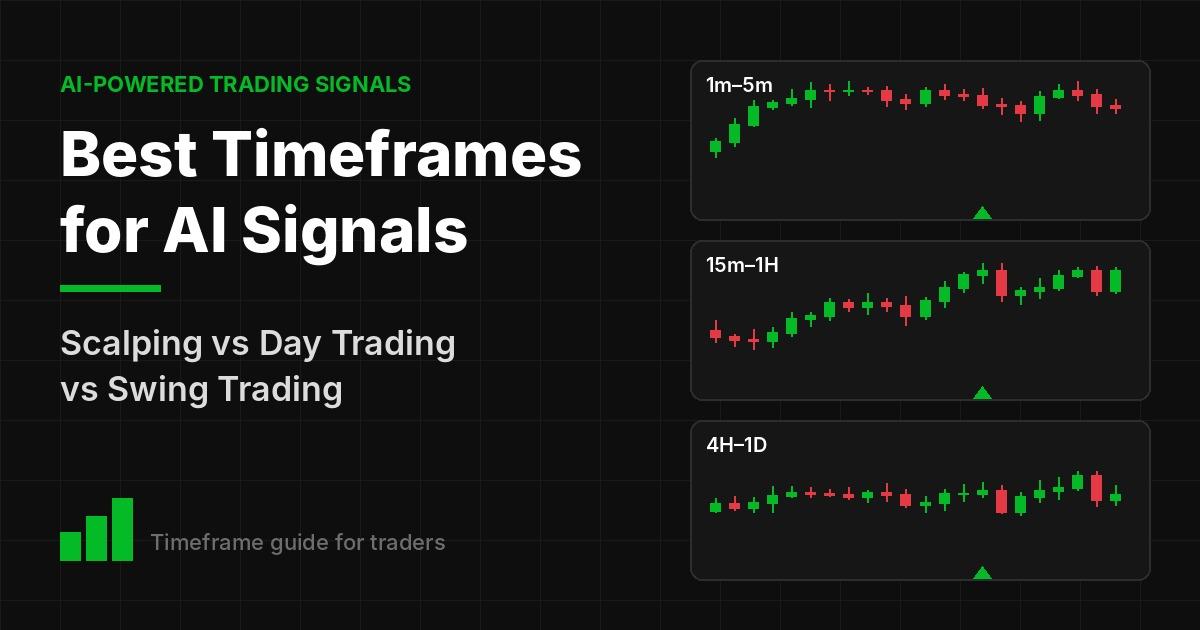
- Scalping (1m–5m): Maximum activity, more noise, and high demands on focus and trading costs.
- Day trading (15m–1H): A practical middle ground with solid signal quality and no overnight risk.
- Swing trading (4H–Daily): Fewer, cleaner signals with minimal screen time, but more patience required.
Most beginners find day trading or swing trading easier to manage. Once you build confidence and discipline, you can explore faster charts if they suit your lifestyle.
Final Thoughts
Choosing a timeframe is a personal decision, and it shapes how AI-powered trading signals perform for you. Start with the style that fits your schedule, test it on a demo account, and stay consistent long enough to judge results fairly. If you are evaluating tools such as GainzAlgo, look closely at independent user reviews, transparent backtests, and clear risk disclaimers before you rely on any signal. Asking “is GainzAlgo legit” is a sensible first step with any trading tool. In the end, a careful review of how its signals behave on your preferred timeframe will give you a far more honest answer than any marketing claim.

 English
 Arabic
 French
 Spanish
 Portuguese
 Deutsch
 Turkish
 Italiano
 Russian
 Romaian
 Portuguese (Brazil)
 Greek