


Understanding the Difference Between Test Cricket, ODI and T20
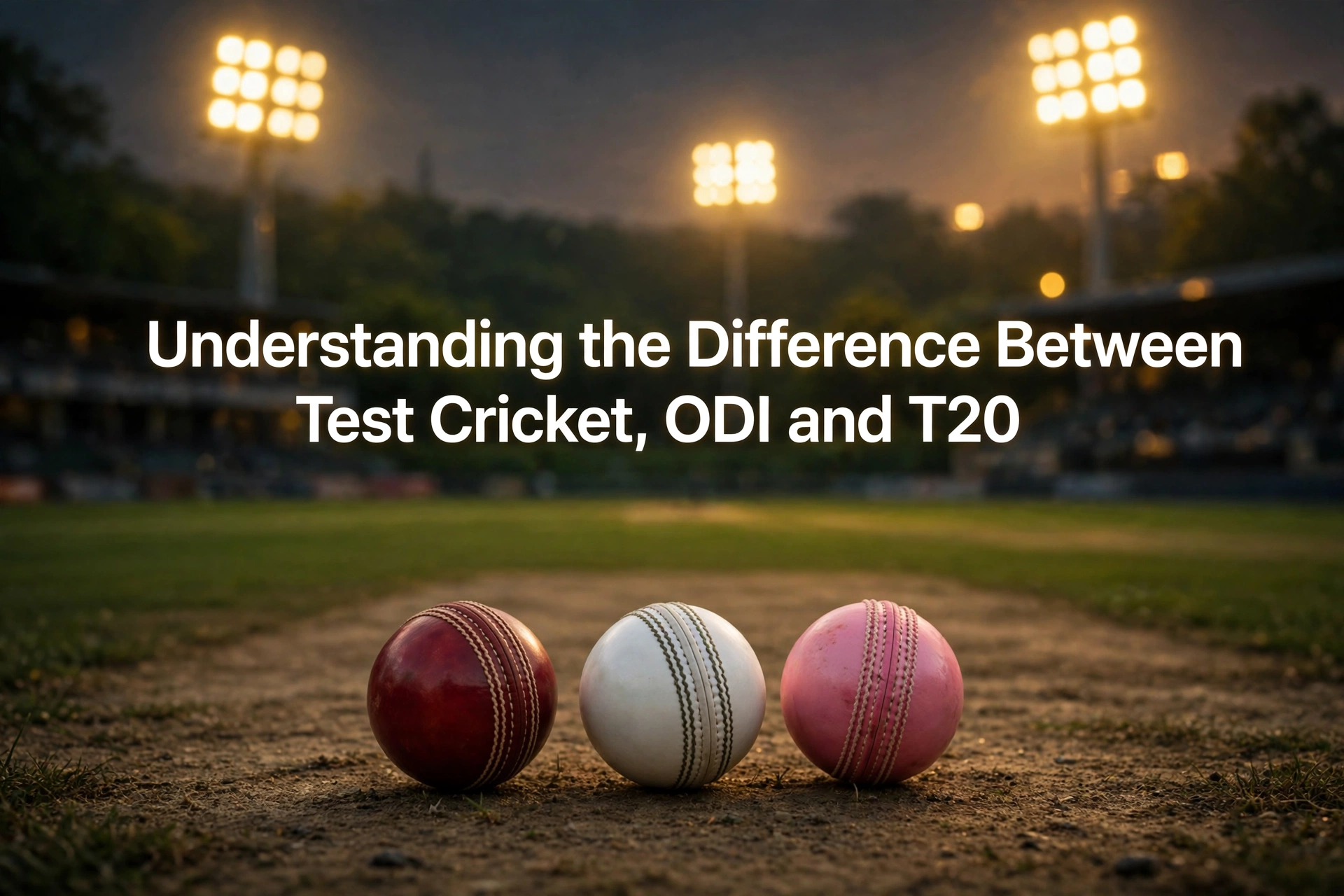
A colleague gives you a call to watch a match on skyexchange, "how long will it be?" is your reply. "Three hours, one whole day, or five days" is the reply. Now that sums up cricket. Same bat, same ball, but three very different games. A glance on skyexchange would reveal the same thing, the Test scores crawl along for days, whereas T20 scores change after virtually each ball.
Here's all you need to understand about the pitch: length, overs, batting, bowling and the results. After reading those up, the scorecard will become a doddle to interpret, no matter which skyexchange score page you're looking at.
The One Difference That Explains the Rest
The difference is time. Time is the one factor that determines everything else A test match may be limited by days, not overs. An ODI and a T20 are limited by overs not days.
In a Test, a side bats for any length of time they like over five days. In 50-over cricket, a side has 300 legal balls. In T20, it has 120. A Test batter can leave ball after ball if he chooses to do so.
Test Cricket: Two Innings, Five Days
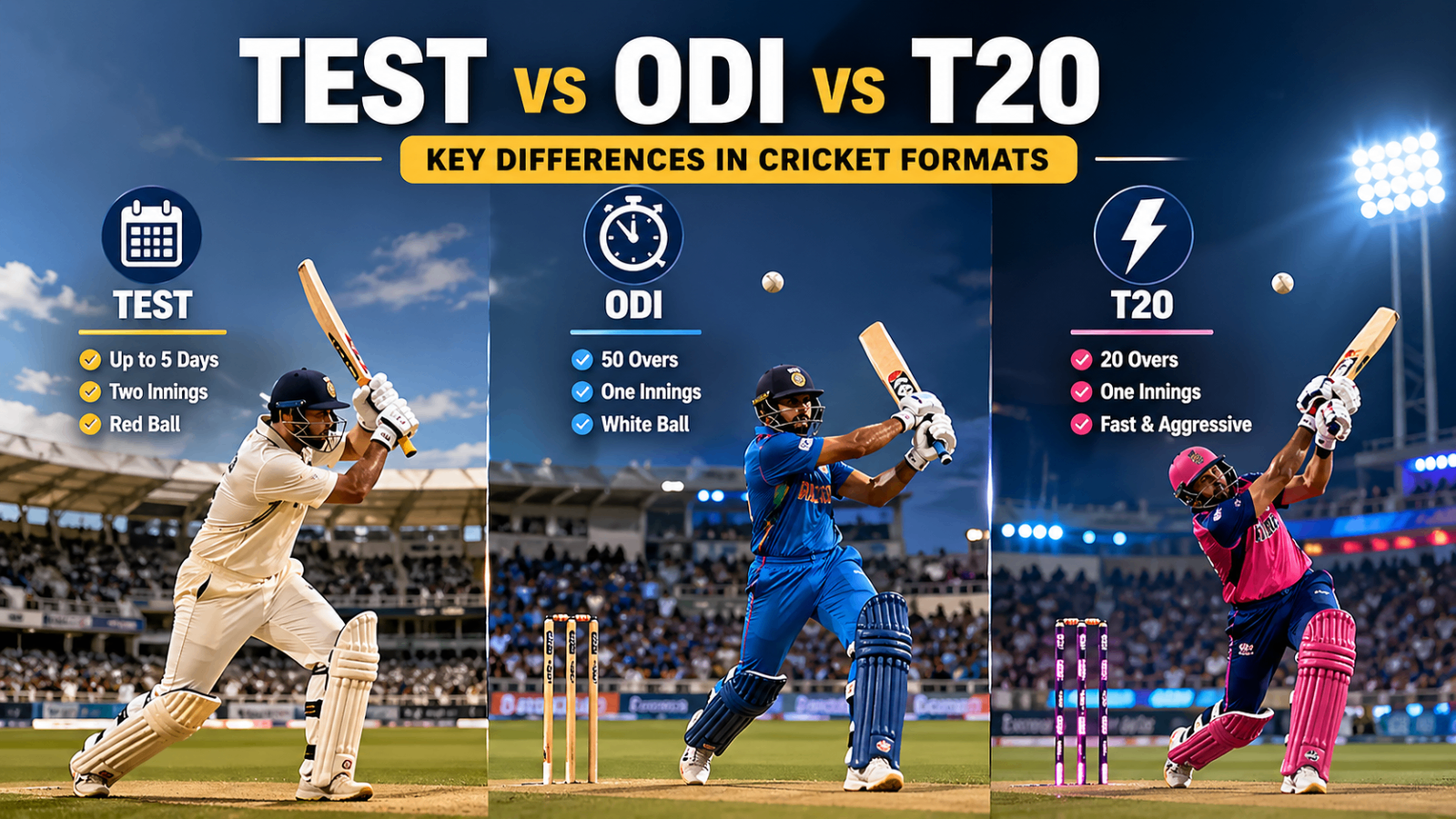
Test cricket is the original version of the game. Both teams play two innings each in an up to five day match. In order to win a match, a team has to score more runs than the opposition and bowl them out twice in the match, if that's not possible and there isn't enough time, then the match is a draw.
In Test there is no restriction on the overs in an innings or by a bowler. An innings can be declared closed before ten wickets fall by a captain. If you are watching a five-day Test on skyexchange, you check in once or twice a day, because it's a slow burn.
Why a Draw Exists Only in Tests
A draw is not a tie. A tie indicates the side was equal at the end. A draw indicates time expired before a result was reached (only in a Test).
ODI Cricket – One Day, 50 Overs a Side
An ODI consists of one innings per team of 50 overs, and the game has completed in one day in around seven or eight hours. The ODI cricket rules are between those of Test and T20.
A captain, therefore, has to have at least five bowlers as no bowler can bowl over 10 overs in an ODI. The powerplay is split into three parts: 2 fielders outside the 30-yard circle in overs 1-10, 4 in overs 11 to 40, and 5 in the final 10. Go to skyexchange in a odi is middle overs.
T20 Cricket: 20 Overs. No Time to Settle
In T20 cricket, each team gets one innings of 20 overs and the game ends in roughly three hours. A bowler can't bowl more than four overs, meaning a captain requires five bowlers to get through the overs. Powerplay occurs during the first six overs.
There's just not time for it in T20. For every ball you face without scoring, you're wasting a twelfth of your entire game. And that's why T20 cricket boasts more sixes, more wickets and more sudden volatility than either of the other formats. On skyexchange, T20 scores happen quickly.
How Batting Changes Across the Three Formats
That is where it is most obvious: Batting. In a Test, a batsman only has one task and that is to get through it. A hundred in a Test is now deemed to be over 200 balls, just to get there and this is perfectly standard.
A batter has to work in phases in an ODI. The first 10 overs is to hit the ball above the infield, middle overs are to give the strike back, and the last 10 overs is to hit the ball hard. In T20, it is not like that. You have to hit straight from the first ball. Skyexchange batting stats reflects that.
-
Test batting is about survival, patience and tiring out bowlers over hours.
-
ODI, batting is a time-setter for a natural climax at the death.
-
T20 batting is about hitting straight away.
How Bowling and Fielding Change
Bowling is very different. In a Test, fast bowlers can go for long spells and a spinner can bowl 30 overs in a day. There's no maximum number of overs, so the captain can keep his best bowler on.
In a game that is spread by rule in limited-overs cricket, the bowler's role is just as much to constrain scoring as it is to take wickets. Yorkers, slower balls and wide lines are more significant, because in a one-over spell a bad over can be decisive in a game. Look at the skyexchange bowling figures and you'll spot that divide.
Powerplays, in Simple Words
You get certain overs where only a certain amount of fielders are allowed outside the circle. The rules vary by format: there is no powerplay in test cricket, an ODI has three and T20 has one: the six overs of the first over.
Balls, Results and What Happens When Scores Are Level
Matches use a pink ball at night and a red ball during the day. ODIs and T20s use a white ball.
Game formats are different as well. A Test can result in a win or a draw or, very rarely, a tie. An ODI or T20 can't end in a draw, but they do have rain-affected minimum overs, with 20 per side needed to get a result in an ODI, 5 in a T20. When new fans ask questions about the differences between formats, the minimum overs for a rain result and super over super-over super-over are usually the top of the list.
Which Format Should You Watch First
And no, there's no definitive answer, just the first step that takes into account your available time. Starting with a T20 is the most straightforward option, as it's book finished in one evening.
-
If you are short on time go for T20, see the powerplay and the last five overs.
-
Take a day off, attend an ODI, and see how the middle overs keep the game alive.
-
Want to see the entire game, come to a Test and see a session every session.
-
Whatever you pick, follow the score, the wickets and the overs remaining on skyexchange.
The Concise Summary
Test cricket. 2 innings each 5 days no limit and draw when time elapses. ODI. 50 overs in a day, 1 innings, 10 overs for every bowler. T20. 1 innings, 20 overs just in 3 hours, 4 overs for each bowler. As the format gets shorter the rate of batting goes quicker. Skyexchange. Login. When you can stay up to date with new outlaws, check the results, all at one spot through a skyexchange login and if you are a new user check the skyexchange register measures to set up an account to follow matches there. Skyexchange keeps the current figures we will feel in the blink of an eye no matter what structure.

 English
 Arabic
 French
 Spanish
 Portuguese
 Deutsch
 Turkish
 Dutch
 Russian
 Romaian
 Portuguese (Brazil)
 Greek