


BPC-157 and TB-500: What The Research Says, Side By Side
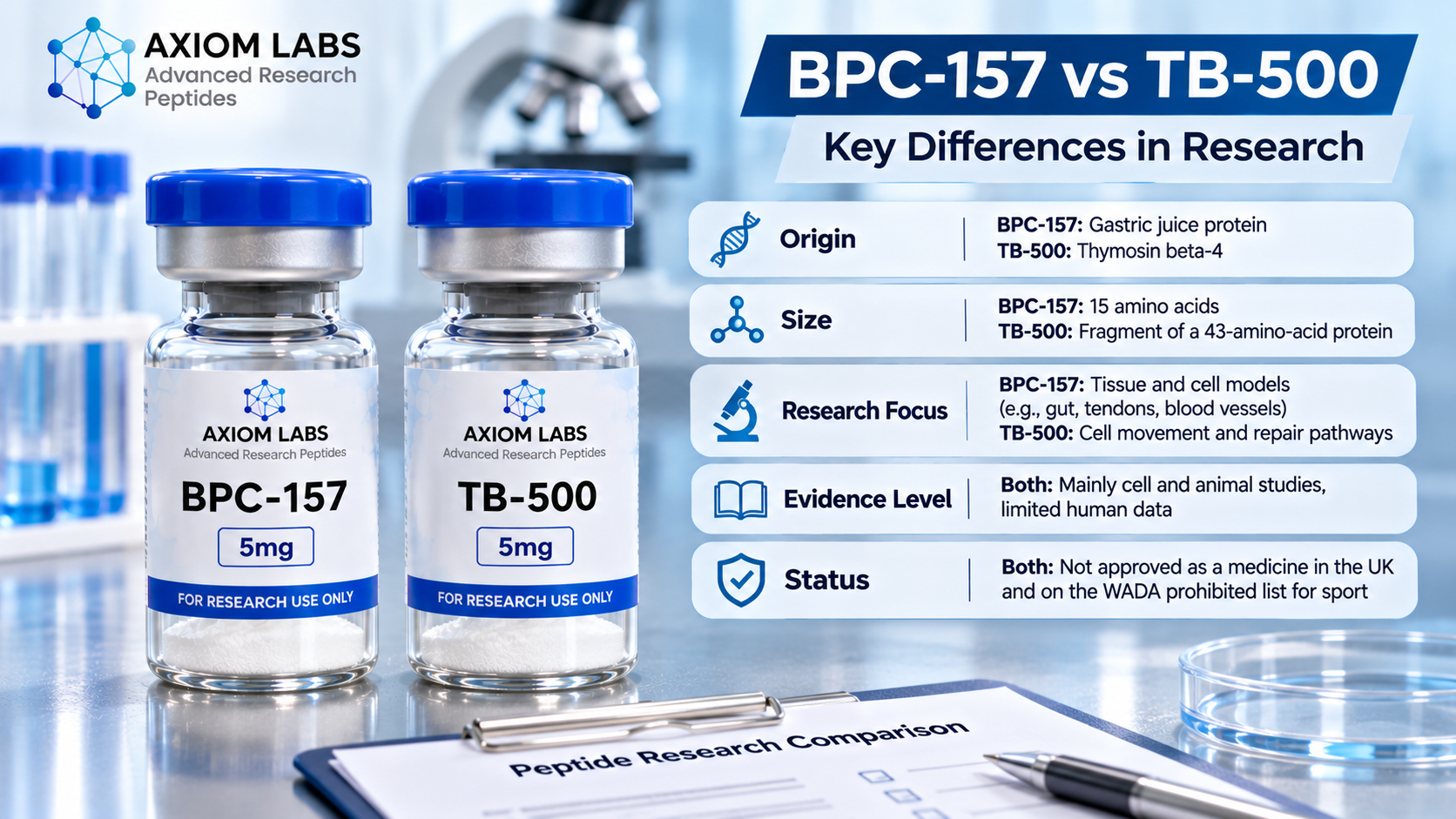
BPC-157 and TB-500 are two of the most searched names in peptide research, and they are constantly mixed up. They share a few headlines and a lot of the same forums, but they are different molecules with different origins and different bodies of evidence. This guide separates them clearly, so you can read the literature with the right expectations.
What BPC-157 Is
BPC-157 is a synthetic peptide made of 15 amino acids. The name stands for "body protection compound", and its sequence was derived from a protein found in human gastric juice. In published research it is studied mainly in laboratory and animal models, where investigators have looked at tissue and cell responses in areas such as the gut lining, tendons and blood vessels. It is a research compound, and to our knowledge it is not approved as a medicine in the UK.
What TB-500 Is
Thymosin beta-4 is a naturally occurring peptide of 43 amino acids, found in many tissues and linked in research to the regulation of actin, a protein that helps cells keep their shape and move. TB-500 is the name commonly used for a shorter synthetic fragment connected to the active region of thymosin beta-4. Because "TB-500" is a trade-style label rather than a formal name, the exact compound sold under it can vary between sources. That is a good reason to ask any supplier for full identification and testing data.
Side By Side
- Origin: BPC-157 comes from a gastric juice protein. TB-500 relates to thymosin beta-4.
- Size: BPC-157 has 15 amino acids. TB-500 is a shorter fragment of a 43-amino-acid parent.
- Research focus: BPC-157 is mostly studied in local tissue models. Thymosin beta-4 fragments are tied to cell movement and repair pathways.
- Evidence level: Both rely mainly on cell and animal studies, with limited human clinical data.
- Status: Neither is an approved medicine in the UK, to our knowledge, and both appear on the World Anti-Doping Agency's prohibited list for sport.
Why The Two Get Compared
Searches for BPC-157 and TB-500 usually come from readers trying to understand how the two differ in structure and research focus. They are discussed together because they appear in the same research circles, not because the evidence shows they work the same way. If you want a deeper walkthrough, this BPC-157 vs TB-500 at a glance summary and the full article behind it cover origin, structure and evidence side by side.
What The Evidence Looks Like
Most published work on both peptides comes from cell cultures and animal studies. That matters because results in a rodent model do not automatically carry over to people. A few things to keep in mind when reading the papers:
- Study design varies. Doses, routes and models differ widely, which makes papers hard to compare.
- Sample sizes are often small, and many studies come from a limited number of research groups.
- Independent replication is still developing. Confirmation by other labs is a key test of any finding.
- Animal data is a starting point, not a conclusion.
None of this makes the research uninteresting. It means the honest framing is "under investigation", not "proven".
Common Misconceptions
Two mix-ups come up again and again. The first is treating BPC-157 and TB-500 as interchangeable names for one compound, which they are not. The second is assuming that a large number of online mentions equals a large body of human evidence. Popularity and proof are different things, and the published record is the only place to tell them apart.
Sourcing Checks For Lab Buyers
Because these are research compounds, the quality of the material shapes the quality of the work. Before choosing a supplier, check:
- A batch-specific certificate of analysis that matches the batch number on the vial.
- The purity method stated (HPLC) and identity confirmed by mass spectrometry.
- The full compound name and sequence details, especially for fragments sold under short names.
- Storage and handling instructions for lyophilised powder.
- Research-only wording, with no personal-use claims.
Reading Peptide Research Critically
A few habits make the literature easier to navigate. Check whether a study used cells, animals or people. Look at who ran it and whether anyone has repeated it. Separate what the authors measured from what a product page claims. And be wary of summaries that skip the limitations section, because that is often where the most useful context sits.
The Takeaway
BPC-157 and TB-500 are active topics in early-stage research, but the evidence is mostly preclinical and the regulatory picture is restrictive. Treat them as research subjects, read the original papers where you can, and hold suppliers to clear documentation standards.
What do you check first when you compare research peptides?

 English
 Arabic
 French
 Spanish
 Portuguese
 Deutsch
 Turkish
 Dutch
 Italiano
 Russian
 Romaian
 Portuguese (Brazil)