


What Is The Difference Between Generative AI And Predictive AI?
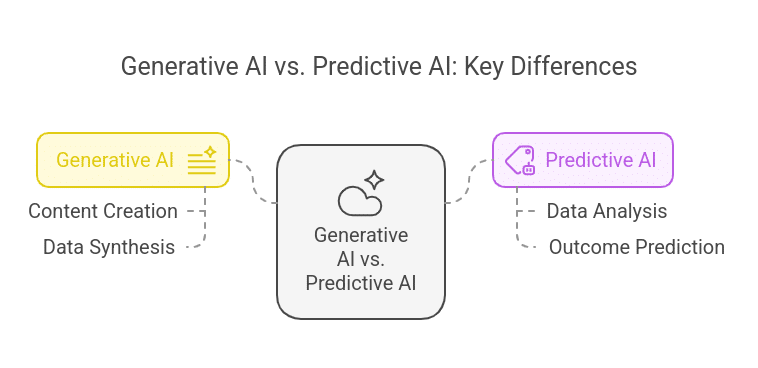
Exploring How Generative and Predictive AI Shape Modern Technology
Artificial Intelligence (AI) has evolved from a futuristic concept to a real-world engine of transformation. From generating lifelike images and human-like conversations to predicting business trends and consumer behavior, AI is reshaping how organizations operate. Yet, within this vast ecosystem, two distinct branches, Generative AI and Predictive AI, are redefining the future of innovation and intelligence.
Understanding the difference between generative AI and predictive AI is more than academic, it’s strategic. Businesses, developers, and even a seasoned cybersecurity consultant must grasp how each model functions to leverage its full potential safely and effectively. This guide explores both types of AI, their core mechanisms, use cases, and the growing convergence shaping the future of artificial intelligence.
Understanding Predictive AI
Predictive AI is one of the oldest and most widely implemented forms of artificial intelligence. It uses machine learning models and statistical algorithms to analyze historical data and forecast future outcomes. In essence, predictive AI answers the question:
“What is likely to happen next?”
How Predictive AI Works
Predictive AI relies on pattern recognition. Using supervised learning, it trains models on historical datasets such as customer transactions, sensor data, or patient health records and identifies correlations that can forecast future results.
For example:
- Regression models estimate numerical outcomes like sales or revenue.
- Classification models determine categorical outcomes like “spam” vs. “not spam.”
- Clustering models group similar data points to find hidden patterns.
Predictive AI Examples
- Finance: Detecting fraud by analyzing transaction patterns.
- Healthcare: Predicting disease risk based on patient data.
- Marketing: Forecasting customer churn or campaign performance.
- Manufacturing: Predicting equipment failure before downtime occurs.
According to Fortune Business Insights (2025), the global market for predictive analytics is expected to reach $43.5 billion by 2030, growing at a CAGR of 20.5%. This exponential rise reflects how central predictive AI has become in business forecasting and risk reduction.
Understanding Generative AI
While predictive AI forecasts, Generative AI creates. It’s designed to produce new content text, images, audio, or code based on patterns learned from existing data. Using deep learning and neural networks, it generates outputs that mimic human creativity and communication.
How Generative AI Works
Generative AI leverages large language models (LLMs) and transformers trained on massive datasets. These systems learn the relationships between words, pixels, or sounds to create new outputs that resemble the training data without copying it.
Generative AI Applications
- Content creation: Writing blogs, emails, or marketing copy.
- Design & media: Creating art, videos, and advertisements.
- Software development: Generating code snippets or testing scripts.
- Healthcare: Synthesizing medical images for training AI models.
- Cybersecurity: Simulating phishing campaigns for employee awareness.
According to McKinsey’s 2024 report, generative AI could add $4.4 trillion annually to the global economy by increasing productivity and creativity. These benefits of generative AI are already reshaping industries from marketing to medicine.
Generative AI vs Predictive AI — Core Differences
While both branches use machine learning models, their goals and outputs differ dramatically. The table below outlines the key contrasts:
|
Aspect |
Generative AI |
Predictive AI |
|
Purpose |
To create new data or content |
To forecast future outcomes |
|
Output Type |
Text, images, code, video |
Probabilities, trends, predictions |
|
Data Usage |
Learns from patterns to generate |
Learns from history to predict |
|
Techniques |
Deep learning, neural networks, LLMs |
Regression, classification, time-series analysis |
|
Primary Use Cases |
Content creation, design, automation |
Forecasting, fraud detection, optimization |
|
Example |
ChatGPT, DALL·E, Bard |
Salesforce Einstein, IBM Watson, Amazon Forecast |
In short, generative AI vs predictive AI boils down to creativity versus foresight. Generative models innovate by producing new data, while predictive models provide actionable insight for smarter decision-making.
Real-World Applications — Where Prediction Meets Creation
Both generative and predictive AI are revolutionizing industries, often working hand in hand. Let’s explore how:
1. Marketing and Sales
Predictive AI analyzes consumer behavior to forecast trends, while generative AI creates hyper-personalized ad copy or visuals. For instance, predictive modeling can identify which audience segment is most likely to engage, and generative tools can automatically craft messages tailored to that segment.
2. Healthcare
Predictive AI helps doctors anticipate disease outbreaks or patient risks. Generative AI can synthesize realistic medical images or simulate clinical trial data for research acceleration.
3. Finance
Banks use predictive AI for risk scoring and fraud detection, while generative AI automates reporting, documentation, and even virtual customer assistance.
4. Cybersecurity
Predictive models identify potential attack vectors based on network behavior. Generative AI creates synthetic phishing simulations to train employees, helping organizations move from reactive to proactive defense, often guided by an information security consultant.
Benefits of Generative and Predictive AI
Both types of AI offer complementary advantages that, when combined, unlock new possibilities across sectors.
Benefits of Predictive AI
- Improved decision accuracy through data-driven insights.
- Reduction in financial, operational, and compliance risks.
- Enhanced forecasting for supply chain and demand management.
- Stronger customer retention through behavioral analysis.
Benefits of Generative AI
- Automation of creative and repetitive tasks.
- Increased innovation and rapid content generation.
- Realistic data synthesis for model training.
- Improved user engagement with AI-driven personalization.
According to Gartner (2025), over 60% of enterprises are expected to integrate both predictive and generative AI capabilities into their workflows by 2026, a sign of their converging importance in AI-driven decision making.
AI in Data Analysis and Business Intelligence
Both AI types have revolutionized AI in data analysis and AI in business intelligence. Predictive models help organizations interpret large data sets, while generative tools visualize findings in accessible, narrative-driven formats.
How Predictive AI Supports Business Intelligence
- Forecasts market trends and demand fluctuations.
- Optimizes pricing strategies based on historical sales data.
- Enhances customer segmentation and product recommendations.
How Generative AI Enhances Data Analysis
- Generates summaries, dashboards, and visual insights automatically.
- Converts complex datasets into natural language narratives.
- Enables faster decision-making through data storytelling.
Together, these models democratize analytics, empowering leaders to act faster with greater confidence.
Predictive Modeling in AI — The Analytical Backbone
At the heart of predictive AI lies predictive modeling, the process of creating, validating, and deploying statistical algorithms that identify likely future outcomes.
Common Predictive Modeling Techniques
- Linear Regression: Predicts numeric outcomes like sales or costs.
- Decision Trees: Maps decision paths and possible results.
- Neural Networks: Learns non-linear relationships in data.
- Time-Series Analysis: Detects seasonal or temporal trends.
These models have become the backbone of enterprise decision-making, helping companies allocate resources efficiently and anticipate customer needs.
Challenges and Ethical Considerations
Despite their promise, both generative and predictive AI bring challenges:
Key Challenges
- Data Bias: Both rely heavily on the quality and diversity of input data.
- Transparency: Understanding how AI makes decisions is critical for trust.
- Privacy: Generative AI can inadvertently reproduce sensitive data.
- Security: Predictive systems can be manipulated through data poisoning attacks.
Ethical Imperatives
Responsible deployment requires robust governance. Organizations should prioritize:
- Ethical data sourcing and bias audits.
- Transparent model documentation.
- Alignment with privacy laws like GDPR and CCPA.
Ethical AI ensures innovation remains human-centered, safe, and trustworthy.
The Future of Artificial Intelligence — Where Generative Meets Predictive
The future of artificial intelligence will not separate creation from prediction; it will merge them. Imagine digital assistants that not only forecast what a user needs but also generate the exact solution instantly.
Emerging hybrid systems already integrate predictive modeling in AI with generative capabilities, allowing adaptive chatbots, dynamic content creation, and autonomous decision engines.
According to PwC’s AI Outlook 2025, such integrated AI could contribute up to $15.7 trillion to the global economy by 2030, reshaping industries, workflows, and human creativity.
Harmonizing Generative and Predictive Intelligence
The difference between generative AI and predictive AI isn’t about competition; it’s about complementarity. Predictive AI gives organizations foresight, while generative AI gives them creative power. Together, they enable businesses to operate intelligently, adaptively, and innovatively.
As Dr. Ondrej Krehel, an experienced cybersecurity consultant USA, I believe the organizations that succeed in the AI-driven era will be those that understand this balance, leveraging prediction to guide strategy and generation to accelerate innovation. The synergy of these technologies will define the next decade of digital transformation, empowering enterprises to not just respond to the future but to shape it.
FAQs Section:
1. What is the main difference between generative AI and predictive AI?
Generative AI creates new content such as text, images, or audio, while predictive AI analyzes data to forecast future outcomes. Simply put, generative AI imagines possibilities, and predictive AI anticipates results.
2. How are generative AI and predictive AI used in business?
Predictive AI helps businesses forecast demand, detect fraud, and improve customer targeting. Generative AI automates content creation, product design, and data synthesis, boosting creativity and efficiency.
3. What are some examples of predictive AI applications?
Predictive AI is used in healthcare for disease prediction, in finance for risk analysis, and in marketing for customer behavior forecasting.

 English
 Arabic
 French
 Spanish
 Portuguese
 Turkish
 Dutch
Dutch
 Italiano
 Russian
 Romaian
 Portuguese (Brazil)
 Greek
Greek